 |
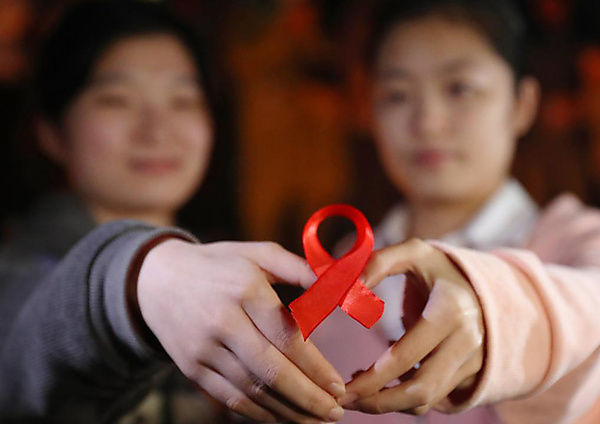
| Students show a red ribbon during an event to raise awareness of AIDS at University of South China in Hengyang, central China's Hunan Province, Nov. 29, 2023. The World AIDS Day falls on Dec. 1. [Photo by Cao Zhengping/Xinhua] |
BEIJING, Dec. 1 (Xinhua) — When two brothers long separated by time and circumstance were finally reunited, they uncovered a family secret that had been buried for years: their mother had died of AIDS and the elder of the two brothers had been born with the virus, but the younger, born after the introduction of preventive measures, had grown up healthy.
The older brother, who had once been given just three years to live, defied expectations and now lives a life many believed was impossible for someone with HIV, having even made his way to university. He is currently supported by the AIDS Prevention Education Project for Chinese Youth (APEPCY), a non-profit organization launched in 2006, through which volunteers deliver free medicine to him regularly.
The brothers' personal story is at the core of "Love Youth," a film that breaks decades of silence and brings youth-oriented HIV education and sexual health awareness boldly to the big screen, aiming to change the public perception and foster a better understanding of the disease.
China reported its first case of AIDS in 1985. As of December 2025, about 1.4 million people are living with HIV in China, with young people accounting for a rising proportion of cases.
Premiering nationwide just ahead of this year's World AIDS Day on Monday, the film tells how China has been supporting young people living with HIV through national public welfare programs like APEPCY.
The theme of this year's World AIDS Day in China calls for united societal efforts to prevent HIV, urging innovation in preventive measures and public awareness.
The film itself marks a pioneering effort in China's AIDS awareness campaign, with its entire cast and crew volunteering their time without pay.
Among the many projects supported by APEPCY is the Linfen Red Ribbon School in north China's Shanxi Province — the only institution in China dedicated to children living with HIV.
The film draws inspiration from a real-life story that played out in the school.
Reflecting on a time when AIDS loomed like a terrifying specter and was barely spoken of, Wang Xia, the school's principal, said that "The mere mention of the word 'AIDS' made people recoil."
"But today, with medical breakthroughs and a society that has become more understanding and accepting, China has made a remarkable jump forward," Wang observed.
The overall prevalence of AIDS is kept at a low level in China, with transmission through blood transfusion largely curbed, and mother-to-child and drug-injection transmission effectively controlled, according to the National Disease Control and Prevention Administration.
Over the past two decades, the school has cared for 127 HIV-positive children from 14 provinces across the country.
Today, 65 of its former students are employed, and some have even started families of their own. Through advances in the prevention of mother-to-child transmission, the young mothers have had healthy children, ending the generational cycle of HIV.
Guo Xiaoping, the school's founder, called its success a "miracle."
"Over all these years, not a single child has died," he said. "Now, the only difference between these children and others is that they take one more pill every day."
Guo, now 62, retired as the school's principal in 2023 but continues to serve as guardian to every child under his care.
"I dream of the day when this school no longer has to exist," Guo said. "When every child with HIV can attend a regular school, and the next generation is born free of the virus, I'll know I've done all I can, and I will finally be able to retire in peace."
The film's closing words echo Guo's motto: "To protect our own children, we must also protect all children."
In 2004, China initiated support policies for people living with HIV/AIDS, as well as their families, including the provision of medications and living assistance. Orphans of deceased AIDS patients also receive free education under these policies.
According to the National Disease Control and Prevention Administration, over 95 percent of people diagnosed with HIV in China are currently receiving antiretroviral therapy, and over 95 percent of those on treatment have reached viral load suppression.
Han Mengjie, chief expert in AIDS prevention at the Chinese Center for Disease Control and Prevention, noted that with no effective, available HIV vaccine, education remains the "social vaccine" in the battle against the virus.
Zhang Yinjun, the film's chief production planner, explained that the real challenge in HIV education for young people today isn't that the topic is untouched, but the deep, structural silence surrounding it.
"Sexual health and HIV prevention have long been overlooked in families, schools and society, and people tend not to talk about these things directly," Zhang said.
She noted that this avoidance makes it more difficult to share vital knowledge effectively, thus young people are less likely to fully develop the understanding and habits they need to protect themselves.
"Ending AIDS isn't just about medicine and testing; it's about creating a culture of understanding, acceptance and love," Zhang added.
(Source: Xinhua)
Editor: Wang Shasha