 |
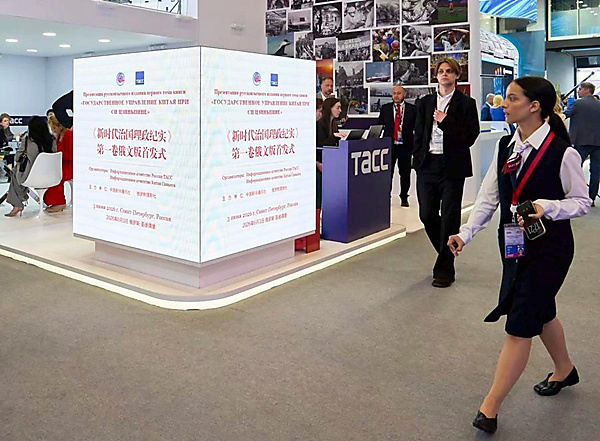
| People walk past screens displaying information of the launch ceremony of the Russian edition of the first volume of "China's Governance Under Xi Jinping's Leadership" at the 29th St. Petersburg International Economic Forum in St. Petersburg, Russia, June 3, 2026. [Photo by Guo Feizhou/Xinhua] |
The Russian edition of the first volume of "China's Governance Under Xi Jinping's Leadership" was recently launched in St. Petersburg, Russia.
BEIJING, June 14 (Xinhua) — Chinese President Xi Jinping's governance philosophy provides useful references for other countries to pursue modernization, foreign experts have said.
The Russian edition of the first volume of "China's Governance Under Xi Jinping's Leadership" was recently launched in St. Petersburg, Russia.
Sheradil Baktygulov, director of the Kyrgyz Institute of World Politics, said Xi's governance philosophy deeply embodies the fundamental principles of China's development.
The philosophy, in his view, features a people-center development concept, comprehensively deepening reform, advancing law-based governance and strengthening Party self-governance.
"These ideas, principles and policies have led China to historic achievements and transformations, advancing the modernization of the public administration system," Baktygulov said.
China has historically eradicated absolute poverty, significantly increased average life expectancy and expanded its operational high-speed railway network to more than 50,000 km, he said. "And this is just a fraction of the high-quality changes taking place in China."
Former Kyrgyz Foreign Minister Alikbek Dzhekshenkulov said a key feature of Xi's governance philosophy is the integration of strong Party leadership with effective governance, the modernization of China's system and capacity for governance.
"President Xi Jinping has not only strengthened Party discipline but also established long-term development goals," he said, noting that the Chinese leader's ideas and policies have helped successfully address the tasks of the era, like maintaining social stability, promoting economic development and implementing major civilizational projects.
Dzhekshenkulov said the book highlights Xi's idea that the people's aspiration for a better life is the Party's goal, which is not merely a slogan but a fundamental principle of governance.
Anastasia Savinykh, an analyst at the Belarusian Institute for Strategic Research, said the book does not stop at abstract theoretical exposition but contextualizes theories and the modernization of China's system and capacity for governance through tangible real-world practices, such as poverty alleviation, industrial upgrading, advances in science and technology, full and rigorous governance over the Party and more proactive foreign policies.
Igor Maksimtsev, rector of St. Petersburg State University of Economics, said the governance philosophy substantiates that modernization does not entail blindly copying Western or any other external models.
While thoroughly drawing on global practices, China not only proceeds from its national realities and draws strength from its own identity and culture, but also shifts its focus from GDP growth as the sole measure of success to pursuing high-quality development and enhancing people's well-being, he said.
Andrey Deryabin, a China expert at the Far Eastern Federal University of Russia, said that China prioritizes periphery diplomacy in its foreign policy while upholding the principles of amity, sincerity, mutual benefit and inclusiveness, thereby effectively promoting international cooperation.
(Source: Xinhua)
Editor: Cui Rui