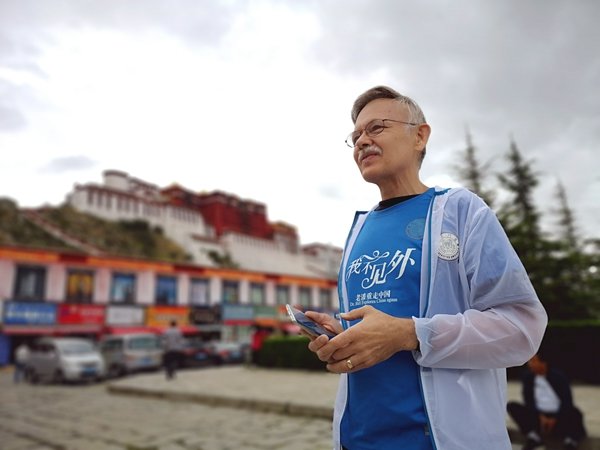
"Modern and ancient, peace-loving, growing while greening — these are the words I would like to use to describe my overall impression of China. China's future is fairly predictable, because policies and practices are based on the country's systematic and scientific governance, led by its Party, the Communist Party of China." — William N. Brown, from the United States
William N. Brown, from the United States, is a business professor with Xiamen University, in Southeast China's Fujian Province. He is well-known to many of Xiamen's residents, who affectionately call him "Lao Pan," or "old Pan." Brown once described his deep ties with China as his "prearranged destiny." China, the distant Asian nation on the other side of the Pacific Ocean, lured him to its shores; once here, it continued to fascinate him for 30-plus years, and it made him an eyewitness to and disseminator of the huge changes in its development.
Letters Across Pacific Ocean
Brown in 1988 resigned as senior vice-president of First American National Securities, and he moved his family to Xiamen, where he has since taught MBA (Master of Business Administration) courses at Xiamen University.
In 1992, he became the first foreigner in Fujian Province to receive China's permanent residence permit. In addition to teaching, he has helped 13 Chinese cities, including Xiamen and its neighbor, Quanzhou, win medals in the International Awards for Livable Communities. "What surprised judges, during their evaluations, have been the emphasis and investments those Chinese cities have put into environmental protection. When they (the cities) made mistakes, they learned to improve," Brown recalls.
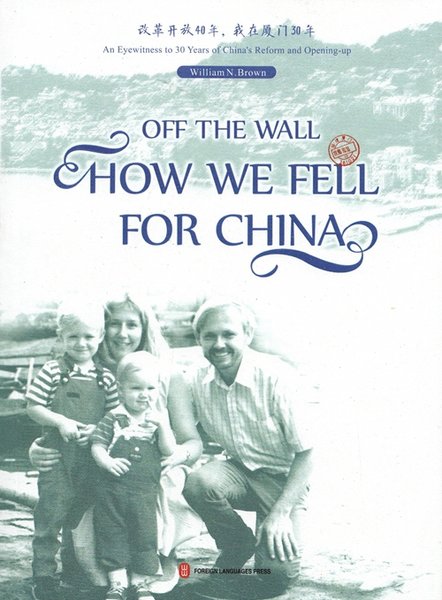 |
| Off the Wall — How We Fell for China, a book written by William N. Brown |
In October 2018, Brown's book, Off the Wall — How We Fell for China, was published. The book is composed of 47 letters, written by Brown, about his life in Xiamen. Those letters were sent to his family and friends in the United States. Upon completing his book, Brown sent a copy to Chinese President Xi Jinping, and he was truly surprised and honored when he received a reply from Xi.
In the letter to Brown, Xi lauded the professor's dedication of 30 years — during the prime of Brown's life — to the educational cause of China, and said he was touched by Brown's deep affection for Xiamen and the country. Calling Brown an eyewitness to China's reform and opening up, Xi appreciated him having represented Xiamen and Fujian Province, and telling stories of China to the world.
The letters published in Brown's book detail the changes in Xiamen, and some other areas of China, from a foreigner's eyes. Of the 47 letters, 30 were written between 1988 and 1990. Chen Yuanhui, one of Brown's students during the 1980s, recalled when she studied at Xiamen University, Brown often invited his students to his home on weekends to sing, chat, make dumplings and barbecue. Letter No. 27, entitled "Turning the Tea Table," and Letter No. 34, "When Silence Is Not Golden," detail Brown's reflections on education in China. He summarizes the way to teach Western culture in a "silent" Chinese class, including how to encourage introverted Chinese to raise their hands and answer questions.
The book also includes a collection of Brown's family photos, including photos of himself, with his wife Susan, and with their two sons, the wedding photo of his son Matt and his daughter-in-law, and a photo of a pile of letters covering his desk.
Brown's family stories, filled with deep affection for China, coincide with some of the most remarkable changes in Chinese society over the past three decades. In this way, a vivid –– and real –– picture of China is presented.
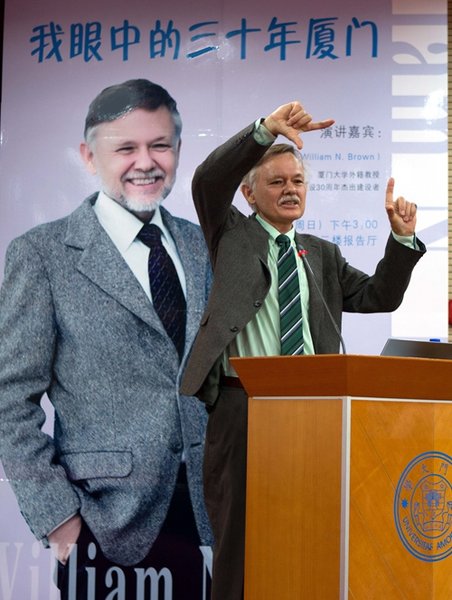 |
| William N. Brown gives a lecture highlighting his 30 years of life in Xiamen |
CPC's 100 Years of 'Routine Miracles'
In late July 2021, Brown posted an article on China Today website; in that article, he shared his understanding of the 100 Years of "Routine Miracles" achieved by the Communist Party of China (CPC). On July 1 that year, a grand ceremony was held in Beijing's Tian'anmen Square to commemorate CPC's centenary. During the July 1 ceremony, Xi, also General Secretary of the CPC Central Committee, declared the completion of the country's first centenary goal — building China into a moderately prosperous society in all respects.
"Any of China's great achievements Xi mentioned in his address would be considered miracles in any other country. Yet, in China, they do not surprise me," Brown wrote in his article. "With the same creativity and perseverance in which the country carried out its targeted poverty-alleviation campaign and contained the COVID-19 pandemic, China now leads the world in fighting desertification, deforestation, food and water insecurity, illiteracy — virtually all of the global challenges that face every country."
Brown explained how, since the founding of the People's Republic of China, in 1949, poverty reduction has been the top priority of the country, with the objective of greatly improving people's lives, and how pragmatic Chinese leaders have fought poverty throughout the decades.
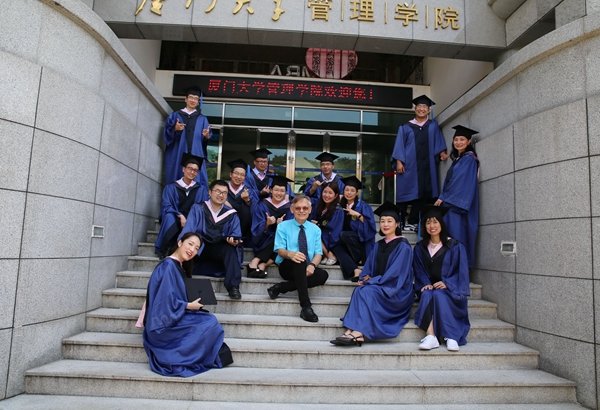 |
| Professor Brown with his students from School of Management, Xiamen University |
During the past three decades, Brown has driven — nearly 200,000 kilometers — throughout China. He has visited Northwest China's Ningxia Hui Autonomous Region, which was once deemed utterly hopeless by the United Nations. "But early on, the ever-pragmatic Chinese adopted the pragmatic strategy of 'roads first, then riches,' as they believed transportation infrastructure is fundamental to development. Very simple, very pragmatic — and it worked," Brown wrote.
In 1994, Brown spent three months driving nearly 40,000 kilometers around China. Then, more than 20 years later, in 2019, it took him a mere 32 days to retrace the same route. "Even those once-poorest villages in Ningxia now have concrete roads that lead right to the villagers' doorsteps. The most amazing thing, to me at least, was that not only did people in remote valleys in Southwest China's Xizang Autonomous Region have access to electricity and the Internet, but they engaged in thriving online e-commerce!" Brown recalled.
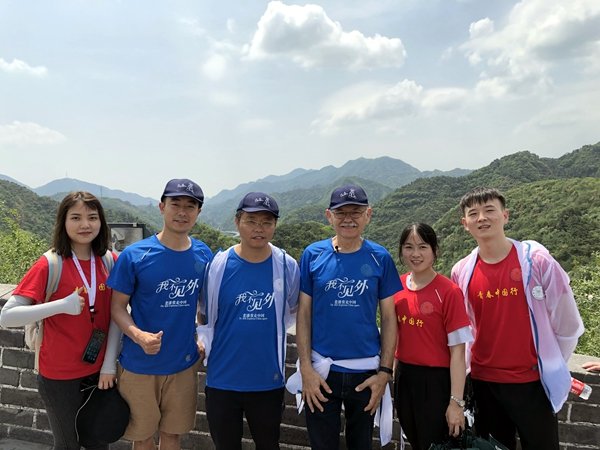 |
| Lao Pan and his Chinese friends |
During his trip, Brown asked the people he met across China why their lives had improved. Many gave answers like, "Life is good because policies are good." He then asked, "Why are policies good?" Many of the people replied, "Because our Party knows our needs and cares for us." Wrote Brown: "Even in remote villages, I saw photos of Xi Jinping, who had visited them to understand the unique root causes of their poverty, and then suggested solutions — even as he had done as a young leader in Fujian. I marveled that he set his foot in Pingtan Island 20 times, when he worked in Fujian to help fight poverty. Thanks to his dedication, when I visit there now, I can take the bridge instead of a boat."
In Brown's opinion, no other nation in history has ever tackled poverty "so single-mindedly, and for so long." He believes this is precisely the reason why China, the country with the world's largest population, has accomplished what would be a miracle in any other nation. But, in China, it was simply inevitable because of that old principle — "You reap what you sow."
With the Belt and Road Initiative (BRI) proposed by Xi, China is applying its pragmatic method, "roads first, then riches," in other nations, especially on the continent of Africa. Brown says many of his African friends are grateful for China's BRI, which has brought them hope.
"My youngest son, who lives with his wife and children in Africa, doing volunteer medical and social work, says, in the remotest areas of Africa, he sees Chinese working alongside Africans to help build highways, railways, dams, bridges, ports and airports," Brown wrote in his article. "History proves that a strong China is not a threat to peace, but rather a force for it — and perhaps the only hope for the underdeveloped world that is still struggling in extreme poverty. So, I congratulate China on achieving its first centenary goal of moderate prosperity, and I applaud its attempt to share its experience with the rest of the world."
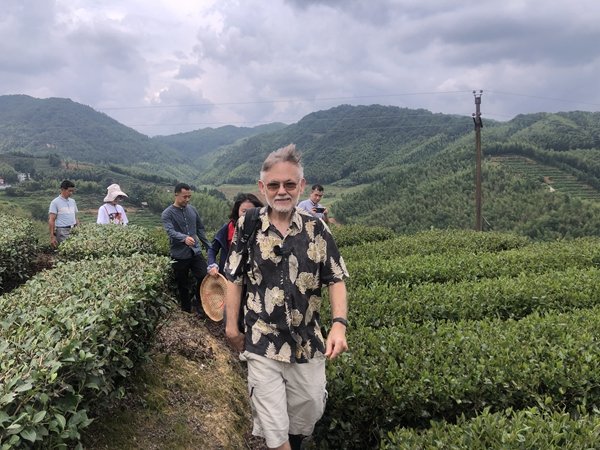 |
| Lao Pan on a field trip in the Chinese countryside |
Looking Forward to Future
During a recent interview with Women of China English Monthly magazine, Brown said he expected China to continue to achieve its development goals in the coming years. "Unlike the China I moved to, back in 1988, life in this country today is so convenient and comfortable. I once joked with my friends, saying 'Chinese had no money 30 years ago, but today, are still without much money,' because we are able to pay for everything with our cell phones," he says.
Brown believes education will continue to improve in China, especially education involving higher research and practical applications, as well as education provided in remote areas. He also believes China will improve its medical-treatment system, telecommunications and computers, and agriculture. "Most importantly, the next step after alleviating absolute poverty is the country's rural revitalization. China has the holistic infrastructure to help people in the remotest areas. The country will improve the livelihood of its people, and it will help slow rampant and unsustainable urbanization, while benefiting the environment," Brown concludes.
Photos from William N. Brown