A 21-year-old nursing student turns a simple bath into safer, more dignified care for older people who need daily assistance.
During her freshman year, Yang Ruiting was volunteering at a nursing home when a bedridden elderly woman made a hesitant request.
"Could you help me wash my neck and toes?"
Yang helped clean her, soaking the woman's feet and carefully washing around her toenails. The woman said nothing, but her body visibly relaxed as she leaned back and let out a long sigh of relief.
For most people, taking a bath is an ordinary part of daily life. But for older people who have lost some or all their ability to care for themselves, bathing can become a difficult task that raises concerns about both safety and dignity.
The experience prompted Yang to think more seriously about how professional care could make a difference.
Now 21 and a sophomore majoring in nursing at Hubei University of Chinese Medicine, Yang is one of the founders of Cenmary, an assisted-bathing center for older people that formally opened in Wuhan, Hubei province, in July 2026.
After her encounter at the nursing home, Yang approached Ai Yating, an associate professor at her university who has long studied geriatric nursing, to learn more about eldercare. Ai introduced her to research projecting that by 2030, China could have more than 77 million older adults who are unable to care for themselves.
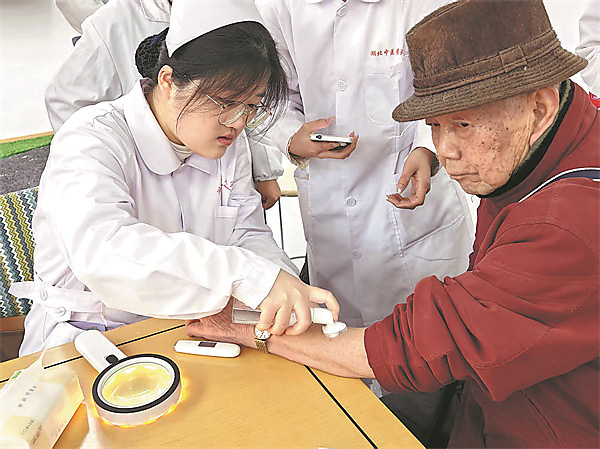 |
| Yang Ruiting (left) conducts a physical assessment of an older adult. [China Daily] |
"Many see the difficulties older people face and feel sympathy, but once that feeling passes, they move on. I don't want to stop at sympathy. I want to use what I've learned to turn that concern into a practical, professional solution," Yang said.
She brought together students majoring in nursing, international business and marketing, as well as an industry mentor from the university.
After visiting welfare institutions and conducting research in local communities, the team decided to establish an assisted-bathing center where older people in need of care could bathe more safely and comfortably.
The team divides its responsibilities based on each member's area of expertise. Nursing students provide care services and help develop procedures and equipment, while marketing students handle branding and community outreach. International business students oversee contracts, operations and finances.
For the nursing team, assisted bathing involves far more than simply helping someone bathe.
Before each bath, team members assess the client's physical condition, check the skin for wounds, review medical instructions, and make sure tubes or catheters are properly secured. During the bath, one team member provides care while another monitors heart rate, blood oxygen levels and blood pressure. These measurements are taken again afterward and recorded.
One client was an elderly man who lived with several chronic illnesses and had been bedridden for years. Even slight movement could cause sharp fluctuations in his heart rate.
His family had long been afraid to bathe him and usually relied on wiping his body with a towel. His daughter felt particularly guilty, knowing that her father had always taken pride in being clean and well-groomed and that, after becoming paralyzed, even a proper bath had become a luxury.
During the home visit, Yang and her team provided assisted-bathing care following standard nursing procedures. Afterward, his daughter's eyes reddened.
"That experience had a profound impact on me," Yang said. "For older people, difficulty bathing is never simply a hygiene issue. It is also about dignity. And for their children, it is about being able to give their parents the care they deserve."
The case also showed Yang how hard it can be for families to care for older relatives when they lack the professional knowledge and practical skills to do so.
The team has since expanded its work beyond individual bathing services by designing equipment to make caregiving safer and easier.
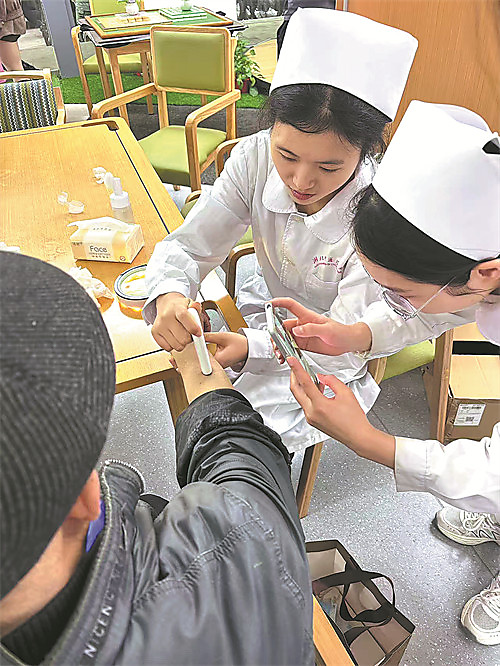 |
| The Cenmary care team records an older adult's condition before bathing. [China Daily] |
So far, it has developed 12 types of specialized equipment and secured nine patents. Its foldable assisted-bathing stretcher trolley has been included in a national catalog of rehabilitation assistive products.
The trolley can be adjusted within a 20-centimeter height range and used with a specially designed transfer sheet, making it easier for caregivers to move an older person from a bed to a bathtub.
The team has also worked with a laboratory in Hubei to develop skincare products for older people, aimed at relieving dryness and itching and reducing the risk of skin infection.
Affordability is another priority.
An assisted bath at the center for an older person who needs some assistance costs 175 yuan ($24), while home visits range from 300 to 1,000 yuan depending on the person's condition and care needs.
Consumption vouchers provided under the national elderly care service subsidy program can cover part of the cost. Yang is also exploring ways to make the service eligible for long-term care insurance and other eldercare support policies so that more families can afford it.
From Service to Profession
The rise of assisted-bathing services comes as China's eldercare sector becomes increasingly specialized.
In 2024, authorities added "elderly bathing assistant" as a new type of work, giving the role a formal occupational identity.
Yang has since noticed a growing number of students taking an interest in the field. Younger people entering eldercare, she said, bring not only training in areas such as geriatric nursing and rehabilitation assessment, but also greater familiarity with social media, online management systems and smart devices.
But the biggest change, in Yang's view, may be how the younger generation sees the profession itself.
For many young nursing professionals like her, eldercare is not simply a way to make a living but also a field in which they can build long-term careers and make a meaningful contribution to society.
"We want to fill some of the gaps in eldercare and help make services more standardized," she said. "We also hope to change public stereotypes about eldercare and assisted-bathing workers, and help the profession earn greater respect."
(Source: China Daily)
Editor: Wang Shasha