 |
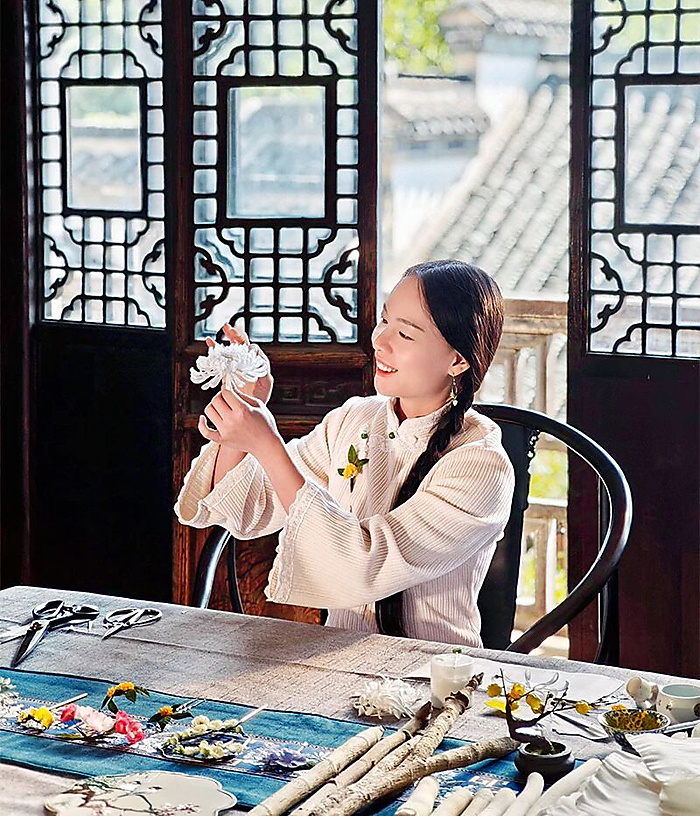
| Zhu Xin, a city-level representative inheritor of Yangzhou's craft of making tongcao flowers |
While visiting Yangzhou, a city in east China's Jiangsu Province, something magical might catch your eyes — various varieties of flowers in bloom, even outside the flowering season. The locals call them tongcao flowers. In fact, they are not actually flowers; instead, they are crafted from tongcao, the smooth pith of tongtuomu, a medicinal herb. These handmade flowers are well-known for their soft texture, elegant colors and realistic appearance. In 2007, Yangzhou's craft of making tongcao flowers was added to the first group of items on the list of intangible cultural heritage of Jiangsu Province.
Time-Honored Decorations
Dry tongcao slices become pliable when moistened, and they will retain their shapes upon drying. As such, tongcao is an ideal material for making artificial flowers. Tongcao flowers, used as decorations in the imperial court, can be traced back about 2,000 years. Tongcao flowers flourished during the Song Dynasty (960-1279). During that time, tongcao flowers, which resembled real flowers, were popular both in the imperial court and among the common people.
The Qing Dynasty (1616-1911) marked the heyday of tongcao flowers. During that period, the craft was especially prevalent in Yangzhou, a renowned commercial and cultural center in ancient China. The city's prosperity had nurtured a vibrant culture, in which the custom of wearing flowers — both real and artificial — in the hair, became cherished among local women, from all walks of life. A group of skilled artisans, who specialized in making tongcao flowers, made their living in the city. Their lifelike, colorful creations even made their way to Europe. Yangzhou's craft of making tongcao flowers, as practiced today, is derived from techniques used during the Qing Dynasty.
Exquisite Skills
Each step in the production process is carried out by hand. The core techniques — pinching, twisting and rolling — require an artisan's exquisite skills. Pinching petals is the most essential — and most challenging — step during production. The artisan begins with a moistened slice of tongcao, shaping it while it is still damp. Using only fingertips, he/she brings out every nuance of curve, fold and layer, ensuring no two petals are exactly alike. A chrysanthemum flower, no bigger than a palm, may have hundreds of petals — each one shaped by hand, without leaving a trace of the fingers.
Once the petals take shape, the assembly begins. The artisan layers them either from the inside out, or from the outside in, carefully adjusting the spacing and angle of each to capture the unique charm of the flower.
Making leaves is equally essential. The artisan cuts tongcao slices into the shape of the leaves. Then, he/she carves delicate veins and gently pinches each one into a natural curve.
A skilled artisan will take two weeks, or even several months, to bring a single pot of tongcao flowers to life. The finished craft captures nature itself — both in form and spirit — as fresh and vibrant as real flowers.
Inheritance, Innovation
Zhu Xin, a city-level representative inheritor of Yangzhou's craft of making tongcao flowers, began learning the traditional craft under Dai Chunfu, a provincial master of arts and crafts, and provincial-level representative inheritor, in 2011. Dai has dedicated his life to the craft with unwavering commitment. Throughout his career, he has concentrated on chrysanthemum-potted landscapes, bringing the traditional form to its pinnacle of exquisite craftsmanship and vibrant artistic spirit.
"What my master taught me goes beyond the craft itself. He often reminded me the essence of tongcao flowers lies not merely in looking real, but in 'being alive.' Every step must respect the nature of the plant, while remaining true to the grace of traditional craftsmanship," says Zhu. "To inherit a craft, one must have a simple and focused heart, consistently refine his/her skills, and strive for excellence. That should be the original aspiration of an artisan."
Zhu has insisted on observing real flowers, studying the curves of petals, and the way the veins run through the leaves. "The lifelike quality of tongcao flowers will never be achieved through a mere accumulation of techniques. Instead, it is cultivated through patient study of nature," says Zhu.
When carving the leaf's veins, Zhu ensures the main vein remains firm, the side veins stretch smoothly, and the finer veins flow gently. As for coloring, she applies thin layers of dye, repeatedly, to achieve delicate gradations — from the center of the leaf to its edge, the color transitions from light to dark, capturing the natural layering found in living plants.
Zhu adheres unwaveringly to a fundamental principle: The "spirit" of tongcao flowers must never be lost. She remains committed to the traditional techniques passed down by her master; yet, she strives to expand the possibilities for tongcao flowers, so the time-honored craft does not merely "survive within museum walls," but thrives and reaches a global audience in the new era.
For centuries, tongcao flowers, which are delicate and tend to soften and warp when exposed to moisture, had been limited to indoor display, or occasional use as hair accessories, with little potential for long-term wear. Zhu devoted years to experimentation and refinement in pursuit of a solution. By optimizing the pretreatment process, and by developing a flexible protective technique, she overcame the longstanding challenges — making tongcao flowers suitable for extended wear or outdoor display.
Zhu has boldly expanded the range of tongcao flowers. Beyond traditional varieties, such as chrysanthemums and peonies, she has developed dozens of new forms, including hydrangeas, water lilies and desert roses. She has also introduced soft, low-saturation hues, giving the flowers a contemporary aesthetic appeal.
Zhu has also developed a range of products featuring tongcao flowers, including mini desktop ornaments and car charms, as well as brooches, hairpins and earrings, to share the charm of tongcao flowers with as many people as possible.
'Rebloom in New Era'
The craft of making tongcao flowers was once on the verge of being lost. Zhu wondered how she could bring the craft to a wider audience? She turned to short videos. In 2019, she began sharing videos featuring tongcao flowers on Douyin (one of China's popular short-video platforms). Many viewers discovered the craft for the first time, and their likes and encouragement deepened her commitment to promoting the craft through short videos.
"Short videos have broken down geographical barriers, bringing tongcao flowers from Yangzhou to the rest of China, and even overseas. A large number of young people have become attracted to learn about this once-obscure, nearly lost craft. In the past, the craft was passed down only from masters to apprentices. Now, many are learning it from online videos," says Zhu.
For her, short videos serve as a bridge, allowing the centuries-old craft to "rebloom" in the new era, while contributing to the inheritance and promotion of this intangible cultural heritage.
Zhu has done her utmost to help the craft take root among the youth. At Yangzhou Intangible Cultural Heritage Treasure Museum, she introduces the history and culture of the craft to visiting children, and she guides them during their experience of making tongcao flowers. She offers experiential tongcao-flower courses in various communities, and in primary and middle schools, allowing children to appreciate the beauty of the traditional craft. She also promotes the craft in more than 20 universities and colleges across the country.
"The children, who have experienced the craftsmanship and beauty of this handicraft, are the hope for the future of tongcao flowers," says Zhu.
When talking about the future, Zhu says she hopes to introduce tongcao flowers to a global audience, to bring this traditional craft wider recognition and appreciation. She also looks forward to more cross-disciplinary collaborations — partnering with different brands and across various fields — to see tongcao flowers thrive in new and unexpected settings.
Photos from Interviewee
(Women of China English Monthly April 2026)
Editor: Wang Shasha