 |
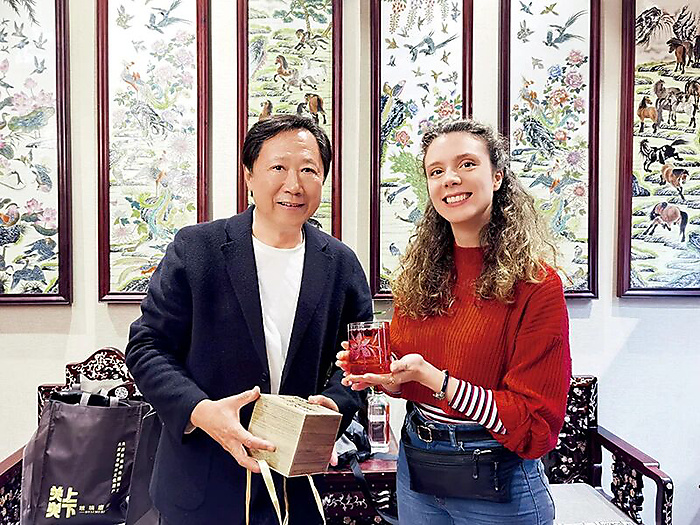
Laura Maria Cinquini and Zhang Chunlin |
Laura Maria Cinquini, an Italian PhD candidate, in world history, at the University of Turin, in Turin, Italy, has been fascinated by the Tianjin glass painting techniques of dyeing, etching and grinding for many years. She has visited Zhang Chunlin, a representative inheritor of the glass painting techniques of dyeing, etching and grinding in North China's Tianjin Municipality, several times to research Chinese glass painting. Since those visits, Cinquini has become a researcher and promoter of the art form.
Deep Interest
Cinquini and Zhang met in July 2025. "On July 13, I received a call from a police officer, saying a foreigner was looking for me. I was startled at the time," Zhang recalls. After a brief conversation, he realized the woman, from Italy, had traveled half the globe to find him. Why? She wanted to learn about Chinese glass painting.
Cinquini's research focuses on modern and contemporary Chinese glass painting. After she read an online article, which introduced Zhang and his work, Cinquini searched for, but failed to find, Zhang's contact information. So, she decided to travel to China to search for him.
As it turned out, Renmin University of China, in Beijing, offered summer courses, part of a student-exchange program with Italy, and Cinquini signed up. She arrived in Beijing on June 28, 2025, to begin the course. On July 13, she traveled to Tianjin, by railway, to try to find Zhang. After she arrived in Tianjin, she told her taxi driver she was trying to find someone, so the driver took her to the local police station. With the help of the police officers, she finally got in touch with Zhang.
"It moved me deeply that an Italian researcher was so passionate about Chinese glass painting that she would cross half the globe to find me. Her dedication and eagerness to learn are truly admirable," Zhang says. At that time, he was out of town, and he could not rush back to Tianjin. So, he asked Cinquini to return to Tianjin the following week.
The two finally met on July 19. While visiting Zhang's studio, Cinquini was excited to see the glass paintings created and collected by Zhang's father, Zhang Fu, the third-generation inheritor of the craft. Zhang Chunlin, the fourth-generation inheritor, grew up immersed in the craft. He began learning glass painting from his father when he was around 6 years old. During the past five decades, Zhang Chunlin has become one of the few craftsmen to master all three techniques — dyeing, etching and grinding — of glass painting. Notably, he has become proficient at integrating all three techniques into his creations.
"Glass painting originated in the West, but later took root in China. Chinese glass painting, which combines Chinese and Western elements, and which appeals to both refined and popular tastes, is a statement to the mutual exchange and influence of Eastern and Western culture and arts," Zhang Chunlin says.
During their visit together, Cinquini gained a deeper understanding of Chinese glass painting. She told Zhang Chunlin she would draft an interview outline, based on her research needs, and she would send it to him to obtain his answers. The two agreed to meet again two weeks later.
On August 2, Cinquini arrived in Tianjin for the third time. Zhang Chunlin took her to the An Family Mansion, in Yangliuqing, a town in Tianjin, so she could appreciate the glass painting collection of a local Tianjin collector. That day, Cinquini and Zhang Chunlin talked for more than four hours about all aspects of Chinese glass painting, but especially about the inheritance and development of Tianjin glass painting techniques.
Glassmaking technology can be traced back to ancient Egypt, around 3000 BC. It eventually spread to Italy, through the Roman Empire, and Italy played a significant role in the history of glass painting. The art form was introduced to China in the 18th century, by missionaries, and it gradually merged with traditional Chinese painting techniques to form a distinct Chinese glass painting style.
During the 1920s and 1930s, glass paintings became a common sight in Chinese households, and they were often presented as gifts during weddings and business openings. Tianjin's glass painting industry remained prosperous until the 1980s, and it was once an important category of Chinese-export paintings. This cultural phenomenon is of great significance, in both art history and the history of cultural exchanges. This, Cinquini said, was one of the reasons she decided to study Chinese glass painting.
Cinquini's fascination with Chinese glass painting began at the State Museum of Hanover, in Germany, where she was an intern while working toward her master's degree at the University of Bologna, in Bologna, Italy.
She helped curate a private exhibition of Chinese glass paintings, which had been collected by a German couple. The experience marked Cinquini's first close encounter with the art form, and it sparked her academic pursuit.
During her stay in China, Cinquini gained a new understanding of the country. "I have just started learning Chinese, and I cannot express myself very well yet. When I first decided to come to China, I felt quite apprehensive. However, after I arrived in Beijing, I found Chinese are very warm and friendly. Whenever I encounter a problem, there is always someone who will help me. The food is also delicious, and I have already fallen in love with this country," she says.
Fulfilling Trip
On April 17, Cinquini visited Tianjin for the fourth time, so she could continue researching glass painting. "Tianjin glass painting is so captivating that I'm back again," she told Zhang Chunlin, when he picked her up at the railway station.
As soon as she stepped into Zhang Chunlin's studio, Cinquini was drawn to a set of glass paintings on the wall. "These works are so unique. I didn't see them the last time I was here," Cinquini said.
"This set of six-panel screens is a collection I sorted out some time ago. They were created by my father in the 1970s, combining elements of craft painting and calligraphy. It is very representative of glass painting," Zhang Chunlin answered.
Under Zhang Chunlin's instructions, Cinquini tried her hand at glass painting. Zhang Chunlin took out a glass plate, and he used a brush to sketch the outlines of two birds on a branch. He then guided Cinquini through the coloring process. Cinquini immediately recognized the motif as the "double longevity" pattern commonly seen in glass paintings.
"Watch your grip, keep your hand steady. Very good ..." With Zhang Chunlin's guidance and encouragement, Cinquini completed her debut piece. "This is my first time creating a glass painting. It makes this trip unforgettable," Cinquini said.
"Since we parted last year, we have stayed in touch. Cinquini shares her research progress with me. She is meticulous in her scholarship, often verifying a single point repeatedly, much like our dedication to detail when making glass paintings. I am delighted that her research will help more people in the world learn about Tianjin glass painting, and about its continuous innovation," Zhang Chunlin said.
Cinquini also visited Xinhua Community College, in Tianjin's Heping District, and had a meeting with experts on history and culture. The experts decoded the artistic genes, folkloric connotations, heritage value and development paths of Tianjin glass painting from various perspectives, including its history, artistic value, aesthetic value and the unique characteristics of its techniques. Cinquini was delighted to get the insights of the experts. She said their insights were extremely helpful for her research.
During her latest trip to China, Cinquini also visited many places, including Yibin and Chengdu, both in southwest China's Sichuan Province, Guangzhou, in south China's Guangdong Province, and Hong Kong and Macao special administrative regions. She traced the footprints of Chinese glass painting across the country.
"Originally introduced from the West, this craft has taken root in China, and it has become a medium reflecting life and recording the times," Cinquini said. Via field investigations and conversations with inheritors, Cinquini has gained an in-depth understanding of the history, techniques and cultural significance of Chinese glass painting. She has also amassed substantial material for her research.
"I have traveled to many places, and I have seen many glass paintings, but Tianjin remains my favorite, because here I see glass paintings with great research value, and artisans like Zhang Chunlin, who have devoted their hearts and souls to the inheritance and development of glass painting. There are many more stories to uncover about Chinese glass painting, and I will keep coming back to China. I hope to build a cultural bridge between the East and the West through glass painting," Cinquini said.
Photos by Cao Tong
(Women of China English Monthly October 2026)
Editor: Wang Shasha