The "Becoming Chinese" trend, sparked by the short videos created by Shirley Zhu, a young Chinese American woman, continues to gain traction on overseas social-media platforms. This online cultural craze has not only ignited non-Chinese netizens' strong interest in understanding and experiencing Chinese culture, but has also fueled the cultural confidence of the new generation of overseas Chinese. With their innovative thinking and unique perspectives, the new generation of overseas Chinese organize and participate in various cross-cultural exchange activities, planting seeds of Chinese culture among the younger generations of people across the globe.
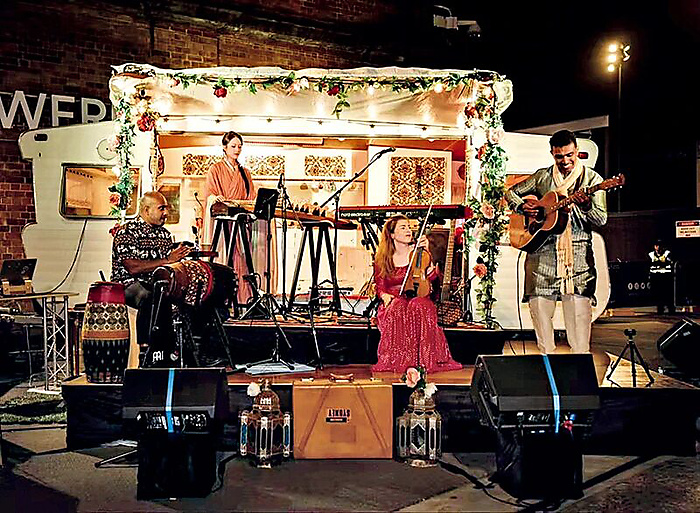 |
| This photo, taken in June 2025, shows Luo Ousiyu (second from left), a young Chinese Australian, with youngsters from different cultural backgrounds playing Chinese and Western musical instruments together. |
Cultural Appeal Growing
Fu Min, who has been living and working in the United Kingdom for eight years, says the "Becoming Chinese" trend has been sweeping across international social-media platforms. Simultaneously, her British friends have been asking her various "digging-deep" questions about Chinese cuisine, culture and brands, such as "How can I order the most authentic Chinese dishes at a Chinese restaurant?" "How can I buy furniture from Foshan, south China's Guangdong Province, through a cross-border, e-commerce platform while overseas?"
Says Fu: "People's interest in China is changing. They are no longer content with a superficial understanding, but rather are eager to delve into every aspect of China, exploring the logic and cultural context behind the phenomena."
Yu Chongyu, a young Chinese living in Australia, agrees. He remembers how when he first arrived in Australia to study, more than a decade ago, he stayed with a host family. When he asked his host where the kettle was, the host looked confused and told him locals drank tap water directly.
"I've experienced many similar differences between Chinese and Western living habits. Now, however, many young Australians are being drawn to the Chinese lifestyle. Not only do they drink hot water, but they also wear cotton slippers, and they have hot congee for breakfast. More importantly, they are not just imitating the Chinese lifestyle out of curiosity. After experiencing it themselves, they truly feel the beneficial changes it brings to their health, thereby recognizing its health value," Yu says.
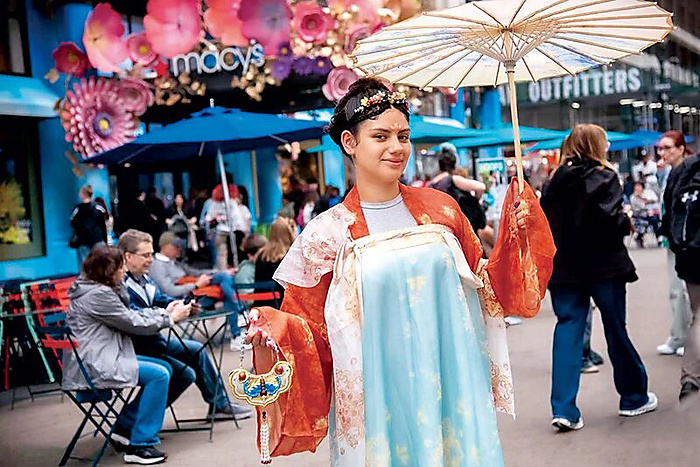 |
| This photo, taken in April 2025, shows a young American woman trying on hanfu during the Car-Free Earth Day activity, in New York, the US. |
In the eyes of most of the younger generations of overseas Chinese, the "Becoming Chinese" trend is not a fleeting Internet meme; rather, it is a reflection of the gradual shift in how people abroad perceive China. It also serves as an entry point, sparking curiosity among people to explore China and its culture.
"In the past, when foreign friends around me talked about China, it was mostly about cultural symbols, like Spring Festival or dumplings. But now, their interest in China is broader, and deeper, often starting from specific details and asking more 'whys.' For instance, during this year's Spring Festival, while I was taking a taxi in Sydney, the driver chatted with me enthusiastically about China's zodiac culture, and even asked me to help him figure out his own zodiac sign," Yu says.
In the United States, Ming Liang, president of the New York Hanfu Society, and her colleague, Ni Meng, have felt this change even more profoundly throughout their years of promoting hanfu culture.
Not long ago, a China-US youth friendship concert was held at the Chinese Consulate General in New York, where young people from both countries performed classic songs from each other's nations.
During the event, an American girl, dressed in hanfu, gave an emotional performance of the ancient-style Chinese song, Sheng Sheng Man — in Chinese. "This American girl has a deep love for Chinese culture. She has learned Chinese songs on her own, and she has a beautiful Chinese name, Wang Yunlan," Ni says.
As director of New York Hanfu Society, and head of its cultural-development center, Ni served as Wang's stylist for the performance. Tailoring the hanfu design to the mood of song, Ni created a traditional Chinese look for Wang, a look that featured an elegant Song Dynasty (960-1279)-style dress, with a Song crown hair accessory.
"During the styling process, I introduced the features and aesthetic concepts of Song Dynasty clothing to her. She listened attentively, and she asked about the etiquette and postures of ancient Chinese people, hoping to more authentically embody the image of a classical Chinese woman on stage," Ni says.
"Unlike the fragmented understanding and symbolic perceptions of Chinese culture in the past, many young Americans today are beginning to proactively explore the deep layers of Chinese culture. During various events, we are often pleasantly surprised to find that quite a few young Americans can not only identify the dynastic styles of hanfu, but they can also explain the cultural connotations behind them," Ming says. "I know an American boy who not only speaks standard Mandarin fluently, but also studies various Chinese dialects, effortlessly capturing the humor of the Tianjin dialect, and the unique charm of the Henan dialect."
Breaking Cultural Barriers
The growing enthusiasm among younger generations of non-Chinese for Chinese culture has been inspiring overseas Chinese to proactively, and creatively, share Chinese culture throughout the world.
In the eyes of overseas Chinese, promoting Chinese culture shouldn't be just about "showing it to others;" it should also require people, from different cultural backgrounds, to "step inside and play together."
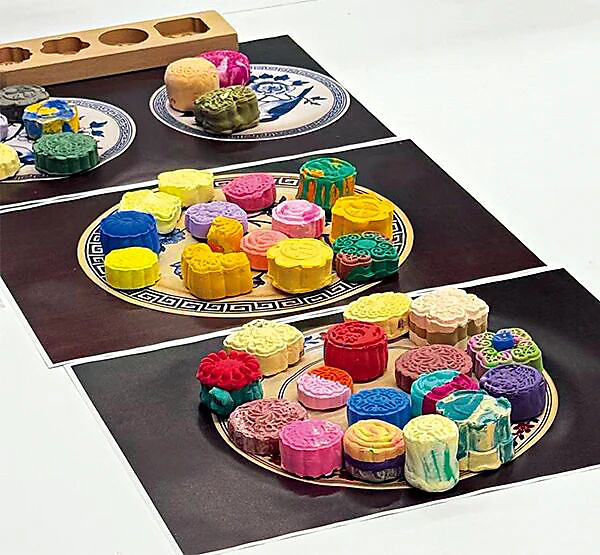 |
| This photo, taken in October 2025, shows the clay moon cakes made by engineers, from various countries, during the Mid-Autumn Festival cultural-experience activity. The event was organized by Fu Min's company. |
Fu is employed by a company that has workers from around the world. In March, Fu and her Chinese colleagues organized several Lantern Festival events within the company. Their colleagues got to experience various activities, such as guessing lantern riddles, and using chopsticks to pick up tangyuan (glutinous rice balls).
"My foreign colleagues had a great time. Through fun games and interactions, they gained a deeper understanding of, and an interest in, Chinese culture," Fu says.
In recent years, Ming and Ni have organized activities to celebrate Huazhao Festival, or Flower Festival (held in the second month of the Chinese lunar calendar, in honor of the flower goddess' birthday). "Whenever we walk down the streets of New York in hanfu, people from different cultural backgrounds are always willing to join us," Ming says.
During this year's Huazhao Festival, the New York Hanfu Society cooperated with a neighborhood revitalization project to decorate the area with traditional-Chinese-cultural elements.
"During the event, a local Chinese youth folk music ensemble staged a guzheng and pipa performance. We prepared various Chinese-style hairpins and accessories, and we invited residents to try on hanfu and experience traditional Chinese makeup and styling," Ming says.
"Trying on hanfu is something Americans, especially the younger generations, particularly enjoy. They always praise hanfu as being 'cool,' and some even take the initiative to join us in introducing the beauty of traditional Chinese clothing to passersby. At times like these, I deeply feel culture has no barriers. As long as you are willing to step toward us, you can become one of us," Ming adds.
Yu, a music lover, has realized, through his frequent interactions with his young Australian friends, that cultural exchanges should not just be about "I perform for you," but rather "we play together."
In his spare time, Yu and his friends often take traditional Chinese instruments, such as guzheng and suona, to popular jam sessions in Australia. They improvise alongside musicians from different cultural backgrounds, many of whom are playing guitars and drums.
"We don't just play Chinese music. We also try using suona to replace lead guitar solos, and guzheng to take over keyboard melody lines. The 'beautiful sounds' created by blending Chinese and Western instruments often earn high praise from our Australian friends," Yu says.
The cross-cultural musical fusion has caught the attention of local cultural authorities. Some cultural events have even begun experimenting with a "mixed-band" model, integrating artists from different cultural backgrounds into the same ensemble, allowing diverse cultures to blend and create on a single stage.
"We hope to inject youthful vitality into cultural exchanges, to move beyond 'you show yours and I show mine' to blend our respective cultures together to ignite new sparks," Yu says.
Making China's Stories More Engaging
From online trends to offline cultural exchanges, younger generations of overseas Chinese have gained new insights into, and reflections on, how — through continuous practice — to expand the "circle of friends" for Chinese culture.
"The 'Becoming Chinese' trend and other down-to-earth online interactions break down geographical boundaries between countries, and they attract a large number of young foreigners to step through the 'gateway' to explore Chinese culture," Ni says. "At the same time, participants can be transformed into communicators. When a non-Chinese wears hanfu and learns some classical Chinese etiquette, they may proactively share this experience with their friends, which, in itself, is an effective form of cultural communication."
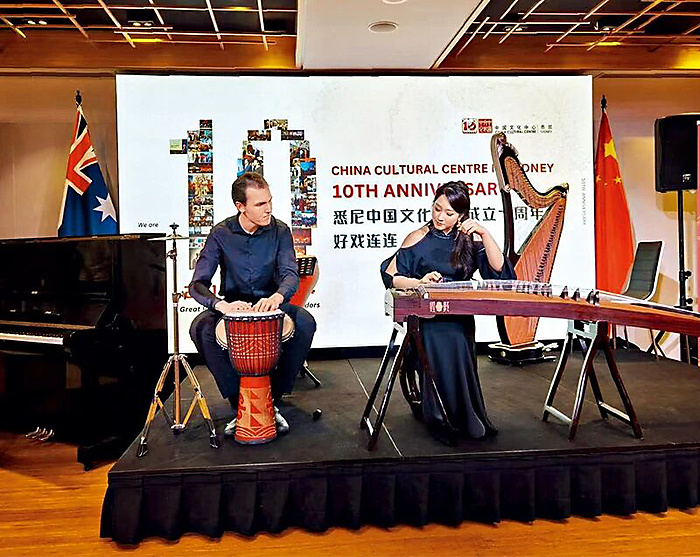 |
| Artists stage a performance during a concert marking the 10th anniversary of the establishment of the China Cultural Center, in Sydney, on November 14, 2024. |
Whether they are foreign netizens, hoping to "become Chinese," or young foreigners, drawn to Chinese culture through various activities, Ming believes each can serve as a bridge for cross-cultural exchanges. "They not only unlock the charm of Chinese culture for themselves, but also inspire their friends, through their personal experiences. What we need to do is broaden access to Chinese culture for more young non-Chinese," Ming says.
During the past Mid-Autumn Festival, Fu organized a cultural-experience event at her company. As part of a photography exhibition, which featured the moon and ancient Chinese architecture, she selected several works by Chinese photographers to show the significance of the moon in Chinese culture. "When my colleagues learned that each exquisite, AI-like photo was actually a real image captured by Chinese photographers, who precisely calculated the optimal relative position of the moon and buildings using the traditional Chinese calendar and astronomical theories, they were all amazed," Fu says.
To explain the origins of the traditional Chinese calendar to her colleagues, Fu first conducted extensive research. The experience helped her realize to be a confident cultural communicator, one must first have sufficient self-confidence and, of course, knowledge of Chinese culture.
Yu agrees. During the second half of last year, the Chinese dance drama, Tian Gong Kai Wu, or Exploitation of the Works of Nature, premiered at Sydney Opera House, where Yu worked as an on-site staff member.
He noticed a large number of non-Chinese audience members in the theater. "Everyone was deeply moved by the technology, culture and artistic beauty in the traditional Chinese farming and iron smelting presented on stage," he says. This reinforced Yu's belief that for Chinese culture to go global, it requires both the "highlight moments" of masterpiece works and the "silent nourishment" of everyday life.
"Seemingly insignificant living habits and minor details are actually excellent entry points for cultural exchanges. We used to think we needed grand cultural products to impress others. But, in fact, when a cultural exchange returns to life itself, it can achieve twice the result with half the effort," Yu says. "Cultural confidence is not just a slogan; in truth, its foundation lies in 'knowing the why behind the what.' Only when we truly understand the emotions and wisdom behind the culture can we tell China's stories that touch people's hearts," Yu concludes.
Photos from Interviewees and Geng Di
(Women of China English Monthly July 2026)
Editor: Wang Shasha