Projects specific to women's craft industry are flourishing across China. From Guangxi's Bagui Qiaoniang, Gansu's Longyuan Qiaoshou, and Shaanxi's Sanqin Qiaoniang to Sichuan's Women's Revitalization Workshops, women's federations, at all levels, have tapped into local specialties and traditional crafts to promote skills training, build brands and match production and sales channels. The federations have created platforms to help women start businesses and/or find employment close to their homes.
The All-China Women's Federation has implemented the Action for Women's Employment and Entrepreneurship, to help women achieve high-quality full employment. Across China, women's federations have guided women as they have engaged in embroidering, paper-cutting, weaving and/or other crafts, which have suited their local traditions, so the women can turn their "fingertip skills" into a vibrant "fingertip economy," which in turn has boosted the women's incomes.
This article focuses on the Women's Revitalization Workshop Project in southwest China's Sichuan Province.
Colorful threads, fine needles and Chinese knots come alive, in the hands of countless women, in rural Sichuan Province, in southwest China. In recent years, Sichuan Women's Federation has helped boost the incomes of women in flexible, home-based employment, by fostering six major women-led industries, including specialty farming, crafts and intangible-cultural-heritage (ICH) products.
To date, 124 provincial-level demonstration bases for women's flexible, home-based employment have been established throughout Sichuan, along with more than 1,800 women-led bases at the city and county levels. In addition, seven Women's Revitalization Workshop service stations have been built in some underdeveloped counties. These initiatives have trained nearly 6.9 million women, helped 1.04 million women secure jobs close to their homes, and enabled quality products from the province to reach global markets. "Fingertip skills" have become a vibrant "fingertip economy," empowering rural revitalization in Sichuan.
Workshops as Foundations
The Women's Revitalization Workshop Project supports women's flexible, home-based employment through cooperation with east China's Zhejiang Province. The project created a model — "unified training + Sichuan products + Zhejiang orders" — to link skills training, product production and sales channels.
In October 2025, the first Women's Revitalization Workshop was formally inaugurated in Danba, a county in Garze Tibetan Autonomous Prefecture, in Sichuan. Since then, craft-skills training have been delivered to grassroots communities, and the sessions have targeted women in pastoral areas, left-behind women, stay-at-home mothers and women college students. The project has also leveraged resources from Zhejiang, to attract orders and open markets. Since then, the workshop in Danba has completed more than 1.4 million orders for crafts, and those sales have helped more than 2,000 Tibetan women earn a living. Sales of agricultural products, through livestreaming sessions, have exceeded six million yuan (US $0.88 million). Those sales have helped promote the local goods across the country.
Hu Yixiao is head of the service center for Women's Revitalization Workshop in Danba. "Women in rural Sichuan are hardworking, clever and skilled. With the Zhejiang-Sichuan cooperation, we bring orders, development approaches and resources from Zhejiang to Sichuan, matching them with Sichuan's labor force, craftsmanship and culture," she says, as she reflects on the project's mission. "We provide practical training, which women can use right in their homes." When asked about the future, Hu says she plans to expand training coverage, deepen cooperation with Zhejiang, and cultivate more women pioneers in rural revitalization.
The benefits of skills training to the local women are readily apparent. For example, Zeren Lamu, from Shiqu, a county in Garze Tibetan Autonomous Prefecture, is founder of Galsang Mama Craft Workshop. As she initially struggled with poor sales, she felt lost. With help from Shiqu Women's Federation, she attended a provincial-skills-training course earlier this year. She was also sent to Hangzhou (capital of Zhejiang Province) to learn how to make crafts, and how to conduct e-commerce. Today, her workshop employs a dozen women, who earn a stable monthly income from piecework.
In Yajiang, another county in the prefecture, 65 women completed a three-day course, in making Chinese knots and social-media operations, in January 2026. They received 4,000 orders, right after the course, and began earning an income while "staying at home."
Yi Embroidery Reaching the World
The Women's Revitalization Workshop Project provides a platform for women to learn skills. Through the project, ICH inheritors, such as Axi Wuzhimo, are leading the way — by promoting traditional crafts at home while sharing the crafts with the world.
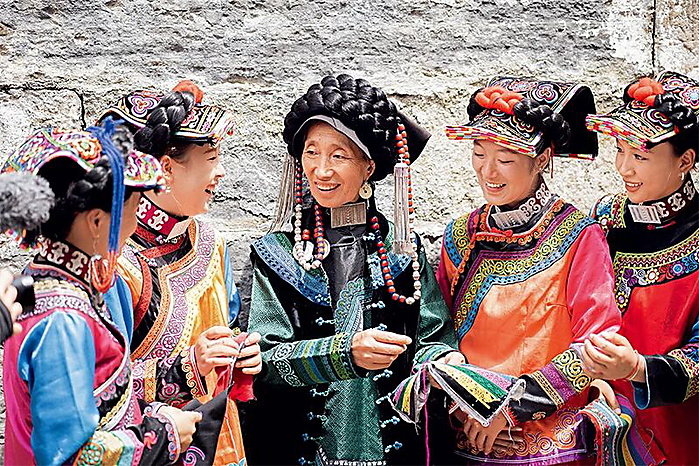 |
Axi Wuzhimo (center) |
In March 2025, Axi Wuzhimo, from Ganluo, a county in Liangshan Yi Autonomous Prefecture, in Sichuan, was named a national-level representative inheritor of Liangshan Yi embroidery. She has delivered Yi embroideries from rural Sichuan to international fashion stages. She has also led thousands of ethnic Yi women in inheriting cultural heritage, while working near their homes and growing their incomes.
Axi Wuzhimo learned to embroider from her grandmother when she was 10. She showed natural talent for the craft. In 1993, she opened the first Yi embroidery specialty store in Ganluo. In 2019, with support from Liangshan Women's Federation, she founded Sichuan's first Yi embroidery cooperative, which has since operated under the principle of "training one embroiderer, influencing one family and lifting a group of women."
The cooperative has provided free training to more than 6,000 women, and helped 1,700 rural women become home-based embroiderers. The embroiders' annual per capita income has risen by more than 5,000 yuan (US $735). The cooperative has been recognized as a county-level ICH workshop, and a provincial ICH experience base.
Innovation keeps ancient Yi embroidery vibrant. While preserving traditional techniques and cultural essence, Axi Wuzhimo integrates Yi embroidery with modern fashions. In 2023, she collaborated with a luxury Italian brand to create a special handbag, which incorporated the Soma flower pattern — an ethnic Yi cultural symbol — into the design. Her works have since been integrated with more domestic and international brands. She has been featured on a program aired on China Central Television, and various other shows. Such efforts have introduced Yi embroidery to a wider audience. "I will keep taking Yi embroidery to bigger stages, and leading more women to a happy life," Axi Wuzhimo says.
From workshops to ICH inheritors, countless women across Sichuan are stitching better lives for themselves. Together, they are painting a grand picture of rural revitalization, and of shared development, with their resilient strength.
Photos from Interviewees
(Women of China English Monthly June 2026)
Editor: Wang Shasha