Village T, officially named Guizhou Provincial Rural Intangible Cultural Heritage Ethnic Costume Fashion Show, is a public-welfare-cultural performance that originated in Kaili, capital of Qiandongnan Miao and Dong Autonomous Prefecture, in southwest China's Guizhou Province. Villagers are the models. They wear their ethnic costumes, and walk confidently as they turn the simple village runway into a window that gives the world a peek into China's ethnic cultures.
Since its debut, in July 2024, Village T has staged more than 900 shows, which have attracted more than 80,000 participants — and nearly 16 billion online viewers. Local art groups like "Village T Mothers" and "Village T Youth" have also sprung up.
Runway in the Mountains
Village T was launched by Yang Chunlin, a young Miao designer who was born in Jiangkou, a village in Wanshui, a town in Kaili, in 1989. Yang was admitted to Xi'an International University in 2007. Given his family's financial situation, his fellow villagers paid his initial tuition fee. He established a Miao costume design studio after graduating, and devoted himself to preserving and promoting Miao culture.
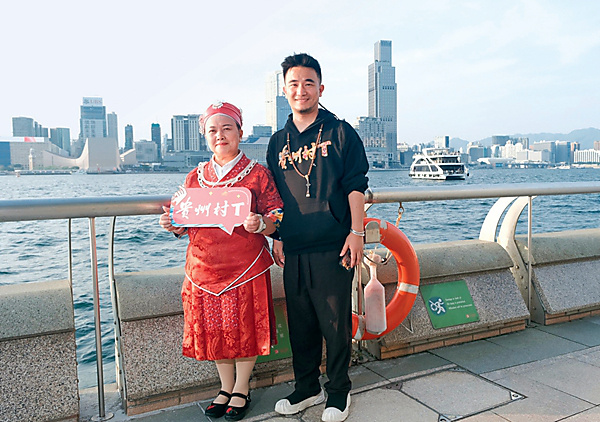 |
Yang Chunlin and his mother |
Yang took his mother, an inheritor of Miao embroidery, to Europe in 2024 to promote Miao culture. During the trip, his mother got lost at the airport. When they reunited, his mother said, "The world is so big. Why not invite people to Kaili to learn about Miao culture?" Soon after, Yang had the idea for Village T.
On July 23 of the same year, the first Village T was held, at Miao and Dong Ethnic Culture Park, in Kaili. Professional models and haute couture were absent, however. Instead, there were children, silver-haired elders and skilled embroiderers, all wearing homemade ethnic costumes, carrying farming tools and local instruments, and walking with natural grace.
Village T became a big hit. It now takes place every Friday to Sunday, and on holidays, at Miao and Dong Ethnic Culture Park.
Ethnic Cultures Shine on Stage
Qiandongnan Miao and Dong Autonomous Prefecture is home to many ethnic groups, including the Miao, Dong and Yao ethnic groups. Each ethnic group has its unique culture. Initially, Village T only presented the cultures of the ethnic groups in Qiandongnan Miao and Dong Autonomous Prefecture. It has since expanded to embrace the cultures of all 56 ethnic groups in China.
In March 2026, women representatives from China's 56 ethnic groups walked the runway at China International Fashion Week, in Beijing. Each representative was dressed in her ethnic group's traditional ethnic wedding costume, as she helped share the beauty of China's ethnic cultures with both domestic and global audiences. "On average, each ethnic wedding costume requires more than 1,000 hours of manual work. The wedding costume of Yang Yuting, the ethnic Miao model, was embroidered by her grandmother and mother over 14 years. These costumes are not only artworks, but also vessels for ethnic culture," Yang Chunlin said, during a subsequent interview.
Village T has given rise to cultural innovations. Many young artists have drawn inspiration from Village T, and they have developed new products, including Miao embroidered hoodies and wax-print shawls. These new products not only preserve the unique charm of the ethnic groups' respective culture, but also incorporate modern fashion elements, which make them highly popular among young people. Traditional intangible cultural heritage techniques, such as Miao embroidering, batik and silver jewelry, have become skills eagerly learned by young people.
Industries Born from Traditional Craftsmanship
Village T has injected new vitality into rural revitalization. It has partnered with intangible-cultural-heritage workshops in more than 50 villages in Guizhou Province.
As an increasing number of people have come to see Village T, the nearby "Xiulitao" Market, which mainly sells intangible-cultural-heritage crafts, has been able to expand its stalls. "With Village T, tourists are lining up!" many stallholders have been reported as saying.
Village T has also helped empower women. For example, it can be connected to more than 30,000 women embroiderers, who have secured home-based employment. The skilled women embroiderers can earn between 3,000-5,000 yuan (US $441-735) per month. On the most recent International Women's Day, women embroiderers, from 16 cities or counties in Qiandongnan Miao and Dong Autonomous Prefecture, presented their respective ethnic groups' costumes on the stage of Village T. Yang Xiaolan, one of the embroiderers, says, "Village T enables us to step out of our homes and onto the stage to show our handmade works. Meanwhile, we can turn our needlework into a source of income."
Hope in Every Step
Village T is a place of warmth — and dreams. Gu Yunye, a 7-year-old girl, often drops by Village T on holidays. "When I grow up, I want to be a modeling teacher, and I want to help kids learn about and love Village T!" she says.
Yang Jiayu's story is touching. The 6-year-old ethnic Yao girl has thalassemia, and she requires a blood transfusion every 20 days. Despite her health challenges, she shines on the stage of Village T. From shows in Kaili to the 2026 CCTV Spring Festival Gala, her smile has touched millions of people. Her mother, Long Xiaoying, says, "No matter how hard it is, I will support her. When she smiles, I'm happy."
This warmth has reached various groups in need of support. For example, in April 2025, children from Qiandongnan Little Turtle Special Children Rehabilitation Center took the stage of Village T. Their bright smiles touched viewers, and they helped raise the public's awareness about autism.
In January 2026, China Children and Teenagers' Fund and Hengyuanxiang Group, in collaboration with Guizhou Women's Federation and Guizhou Women and Children Development Foundation, launched a charity show. The show presented more than 90 hand-knitted sweaters donated for charitable purposes. The children walked with confident steps, and received applause and cheers from the audience. Village T is no longer just a platform for displaying ethnic costumes, but a cradle that carries the dreams of children — and a bond that connects love.
Beauty Seen Worldwide
As the influence of Village T has continued to expand, it has caught the world's attention.
The "Global Village T" initiative was launched during the 2025 United Nations Human Rights Council Social Forum, which was held in the Palais des Nations in Geneva, Switzerland, on October 30-31. "We hope to show the modern vitality of China's intangible cultural heritage to the world, and we want to call on countries around the world to display their ethnic beauty on our Village T platform," Xie Zongxu, a joint PhD candidate with Tsinghua University, in Beijing, China, and the University of Oxford, in Oxford, the United Kingdom, and also the co-founder of "Global Village T," told the forum.
To date, youth from more than 40 countries, including the United States, Germany and Italy, have walked the stage of Village T. Nhial Deng, from Kenya, says, "While watching people from different countries gather at Village T, I have come to realize culture fosters peaceful coexistence and mutual understanding."
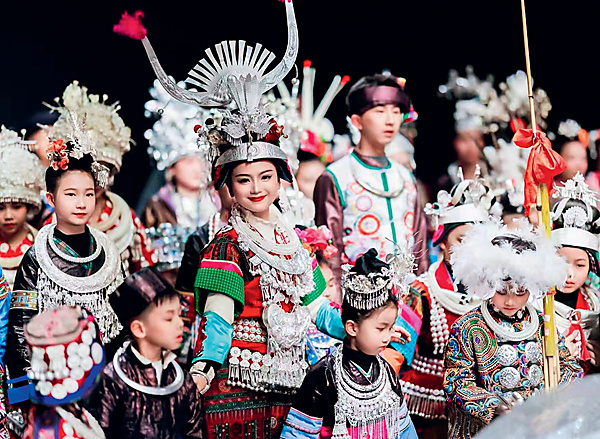 |
Yang Li (middle), operation officer at Village T |
Yang Li, operation officer at Village T, says, "As young people, we have the responsibility to protect and preserve our ethnic culture, and to show it to the world, so more people can see it."
Village T is a testament to cultural confidence, a driver of rural revitalization and a platform that exudes warmth and fosters dreams. Yang Chunlin says the "T" stands not only for "runway," but for "togetherness." This togetherness connects tradition and modernity, and it bridges Guizhou with the world. Through Village T, the world not only sees the beauty of Guizhou, but also witnesses the inclusiveness of Chinese civilization.
Photos from Interviewee
(Women of China English Monthly June 2026)
Editor: Wang Shasha