Wonsook Hong, from the Republic of Korea, moved to east China's Shanghai Municipality in 1993 to study traditional Chinese medicine (TCM). She has since forged an enduring bond with the city. Hong, with her medical skills and benevolent heart, has not only established herself with her patients, but has also spoken up for and offered advice to the expatriates in the city. From a foreigner in search of medical knowledge to a veteran TCM practitioner, and a contributor to Shanghai's development, Hong has written a heartwarming story as she has pursued her dreams and lived a fulfilling life in her "home away from home."
Studying TCM
Hong was admitted to the teacher-training program at Dongguk University, in the Republic of Korea, with plans to become an educator. However, watching a family member struggle with a complex illness, which Western medicine could not treat, caused Hong to reconsider her life's path.
While she was browsing books about China in the library, some books describing the miraculous effects of TCM in treating difficult diseases gave her hope. Those books also sparked her now-deep interest in ancient Chinese culture.
"At that time, I thought there might be hope through TCM treatment," she recalls. Hong decided to change career objectives, and she moved to Shanghai to study TCM. The night before she left Seoul, her mother told her, "Since you have chosen to study TCM, you must give it your all. No matter where you are, always be an upright and kind person." Those words have since been etched in her memory, and they have become her spiritual guide — throughout her studies, her work and her life in China.
In 1993, Hong arrived at Shanghai University of Traditional Chinese Medicine (SHUTCM), and she began her arduous journey of learning TCM. Although she had studied basic Chinese in the Republic of Korea, delving into the obscure classical texts of TCM proved to be challenging. To overcome the language barrier, and to master the professional knowledge, she kept a dictionary by her side, and she spent all of her time studying, with the exception of eating and sleeping.
In 2002, she passed China's medical practitioner qualification certification exam, to become one of the first foreign physicians in China to obtain the certification. She also became the first foreign TCM practitioner registered and employed at a Grade III, Level A public hospital in Shanghai. In 2007, she earned her PhD, in clinical medicine, from SHUTCM. She specialized in treating digestive diseases within TCM internal medicine.
During her medical journey, as a student, the teachings of three esteemed mentors greatly benefited her. Hong's supervisor, renowned Shanghai TCM expert, Professor Ma Guitong, imparted medical skills that helped Hong establish herself in Shanghai. Professor Zhao Guangfu treated Hong like a member of his family, which gave her a sense of warmth and belonging. The encouragement of Chen Kaixian, an academician with the Chinese Academy of Sciences, fostered in Hong the desire to bridge medical exchanges between China and the Republic of Korea.
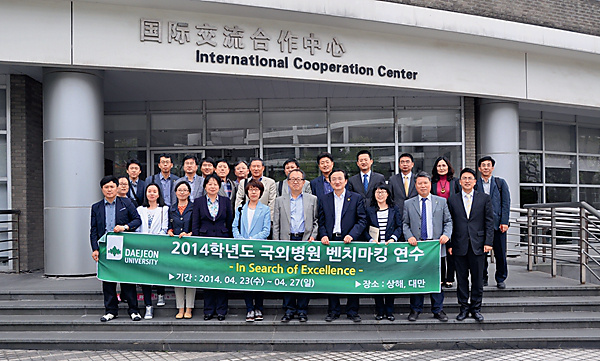 |
| A delegation from Daejeon University, and its affiliated hospital, in the Republic of Korea, visits Shanghai University of Traditional Chinese Medicine, and its affiliated hospital. |
Additionally, she studied under Ding Jinan and Ding Yi'e, descendants of Ding Ganren, with Menghe Medical School, and they helped Hong both delve into the essence of Ding family's medical expertise and strive to promote the TCM.
Medical Career
After obtaining her PhD, Hong worked successively at Shuguang Hospital Affiliated to SHUTCM, Longhua Hospital Affiliated to SHUTCM and Shanghai Minhang District Traditional Chinese Medicine Hospital. She is now an expert invited to work in internal TCM at Shanghai Hechuan•Rhine TCM Hospital, an international medical expert at Longhua Hospital Affiliated to SHUTCM, and a visiting professor at the International Education College of SHUTCM. Hong has earned recognition through her professional excellence.
She always maintains a gentle and patient demeanor when in the consultation room. She believes listening is an important aspect of treatment. For every patient she sees, she sets aside ample time to address their physical and mental concerns, in fluent Chinese.
"TCM practitioners perform clinical assessment through four diagnostic methods — observation, listening and smelling, inquiry and palpation. It involves not only observing physical symptoms, but also paying attention to the patient's psychological state. Listening patiently helps patients feel respected, and it helps improve the effectiveness of the treatment," she says.
When treating patients, especially young patients, Hong often offers advice grounded in TCM-health-maintenance philosophy. In addition to maintaining healthy eating habits and proper exercise, Hong urges young people to pay more attention to their mental well-being, so they can maintain a healthy lifestyle.
"TCM has long held the view that tranquility preserves the spirit, while agitation leads to its exhaustion. Practices, such as meditation and seated Zen contemplation, are excellent health regimens for calming the mind and harmonizing qi and blood. These can help young people find inner peace amid the fast-paced, modern life, enabling them to face and solve problems with a positive and optimistic attitude, thereby effectively relieving stress and adjusting their physical and mental states," Hong says.
Through years of clinical practice, Hong has developed her own area of expertise. She is good at using TCM to treat digestive-system diseases, complex internal and gynecological conditions, and treatment after removal of tumors. She has also accumulated extensive experience in treating sub-health (an intermediate state between optimal health and diagnosable disease). Hong says TCM possesses unique advantages in treating many complex conditions that challenge Western medicine. The greatest strength of TCM lies in its ability to integrate with advanced Western medical techniques to form a two-pronged diagnostic and treatment model, Hong says.
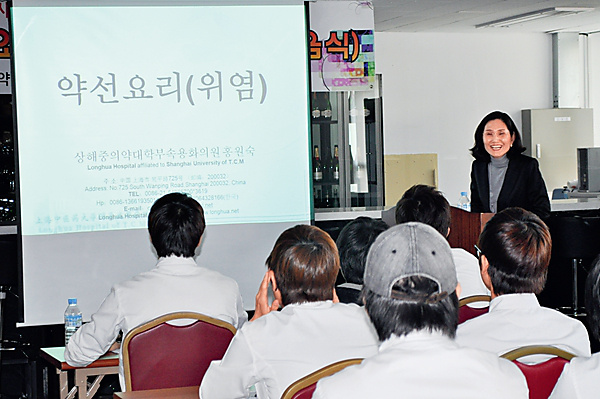 |
| Wonsook Hong gives a lecture, on medicated diets for gastritis, at a medical school in the Republic of Korea. |
"China has done an excellent job in integrating traditional Chinese and Western medicines. We can use Western diagnostic tools, such as electrocardiograms and gastroscopes, to make a clear diagnosis, and then apply TCM methods, like herbal medicine and acupuncture, for conditioning and treatment. This model is worth promoting," Hong says. She hopes to take China's experience in integrating TCM and Western medicine back to the Republic of Korea, so she can promote the mutual development of medicine in both countries.
Hong has been invited to give lectures at several universities in the Republic of Korea. Those talks have helped medical professionals in the Republic of Korea better understand the clinical value of TCM.
In 2014, Hong facilitated a visit to Shanghai's Longhua Hospital by KBS Television Station, from the Republic of Korea, to produce the documentary, The Dream of Traditional Medicine, which systematically introduced TCM to people in the Republic of Korea. The documentary, which aired during prime time in the Republic of Korea, sparked widespread response, and helped change people's perceptions of TCM.
Hong has also promoted establishment of cooperative relationships between SHUTCM and several universities in the Republic of Korea. Thanks to her efforts, 16 delegations from the Republic of Korea have visited Shanghai, and nearly 150 medical professionals, from the Republic of Korea, have attended medical training in Shanghai.
In 2018, Hong played a role in the signing of a memorandum of cooperation (MOC) by SHUTCM and Pusan National University, in the Republic of Korea. That MOC opened a new chapter in medical-education exchanges between the two countries.
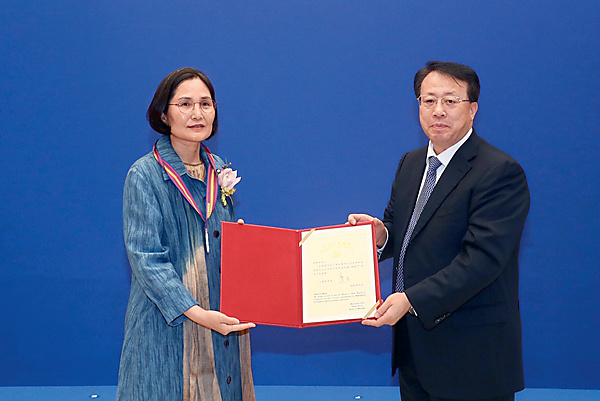 |
Wonsook Hong receives the Magnolia Gold Award. |
In recognition of her outstanding contributions to international exchanges and Shanghai's development, Hong in 2020 was honored with the Magnolia Gold Award by the Shanghai Municipal Government.
Contributing Wisdom
"Shanghai is an inclusive international metropolis that welcomes every newcomer, and it allows us to live and work in peace and realize our value," Hong says.
Hong, invited to be a foreign observer of the Committee for Friendship with Foreign Countries of the Shanghai Committee of the Chinese People's Political Consultative Conference (CPPCC), and who is the first foreign social conditions and public opinion communicator in Hongqiao Subdistrict in Changning District, has consistently focused on the convenience of life for expatriates in Shanghai.
In July 2024, Hong attended a symposium, organized by the Committee for Friendship with Foreign Countries of the Shanghai Committee of the CPPCC, and she offered suggestions regarding entry, travel and medical convenience for foreigners.
Hong proposed strengthening personalized services for physically challenged foreigners upon entry, improving support facilities, such as English-language travel apps, and establishing a rapid-contact mechanism with consulates for foreigners suffering from major and sudden illnesses. After the meeting, she compiled her suggestions into a report, which she submitted to relevant departments.
The report was adopted by the Shanghai Committee of the CPPCC 15 days later. The Foreign Affairs Office of Shanghai Municipal People's Government took the lead in addressing the issues mentioned in the report. The Shanghai Municipal Commission of Transport issued measures to standardize taxi operations and facilitate taxi services for foreigners.
"I was surprised, and happy, to see my suggestions quickly adopted and implemented. This reflects the government's emphasis on livelihood, and also demonstrates China's efficient governance capability," Hong says. In November 2024, Hong was honored with the Excellent Contributor Award by Hongqiao Subdistrict.
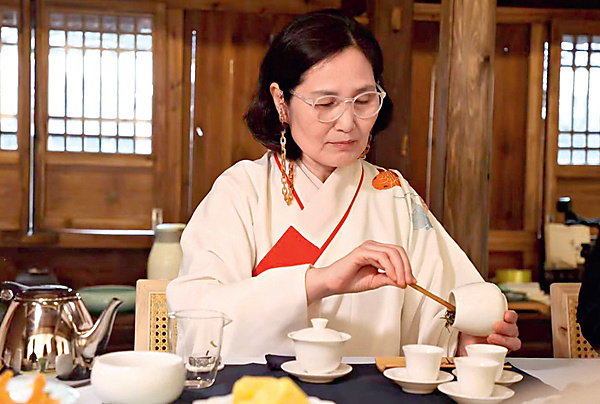 |
| Wonsook Hong enjoys Songyang tea, in Songyang County, in east China's Zhejiang Province. |
Hong is fond of Chinese tea culture. She once made a special trip to Songyang County, in east China's Zhejiang Province, to participate in the tea-culture activity. "Drinking tea helps people calm down and relieve stress, much like the principles of TCM, which emphasize the balance of body and mind," she says. Hong believes everyone should have his/her own hobbies and maintain an optimistic mindset, as these are essential components of a healthy lifestyle.
"The changes in China are comprehensive, ranging from urban development and social welfare to technological progress and cultural prosperity. It's truly breathtaking," Hong says.
She particularly appreciates China's emphasis on the protection and preservation of traditional culture. "TCM is a treasure of traditional Chinese culture. Its remarkable development in modern times could not have been achieved without government support and recognition from the whole society," Hong says.
When asked about her future, Hong says she will continue to practice medicine in Shanghai, and she plans to delve deeper into the field of TCM. She aims to bring health to more patients, and to continue spreading scientific health concepts, to help more people understand the importance of nurturing both body and mind.
Hong plans to continue promoting in-depth cooperation, in traditional medicine, between China and the Republic of Korea. She also vows to continue focusing on urban development, and offering suggestions and helping expatriates integrate into Chinese society.
Photos from Interviewee
(Women of China English Monthly June 2026)
Editor: Wang Shasha