Hezhen is an ethnic minority group with a long history in Northeast China. Hezhen people have long inhabited the Sanjiang Plain, at the foothills of the Wandashan Mountains and where the Heilongjiang, Songhuajiang and Wusuli rivers converge. Hezhen has been known as the Fish-Skin Tribe, as the Hezhen people (with a long fishing heritage) have traditionally used fish skin and bones to make clothes, shoes and decorations. Hezhen fish-skin craft was among the first group of items placed on China's list of national intangible cultural heritage in 2006.
Fish-skin culture is unique to regions in China that are north of the 45th parallel (45 degrees latitude). While historically practiced by multiple ethnic groups, only the Hezhen people in Northeast China's Heilongjiang Province have preserved and passed down this cultural heritage to present day.
Although their traditional fishing-and-hunting lifestyle has been replaced with a combination of farming, fishing and raising livestock, fish remain an indispensable part of Hezhen people's way of life. Specifically, fish skin has been transformed from a daily practical material into exquisite garments and artworks; in fact, fish skin has evolved into the most distinctive cultural symbol of the ethnic group.
The fish-skin craft is a precious legacy of Hezhen ethnic culture. The natural, delicate scale patterns and rustic charm of fish skin, combined with the mysterious undertones of shamanic culture, endow the craft with unparalleled artistic appeal.
Fish-skin products are made from the skins of cold-water fish in the northern regions of China. The skins of cold-water fish have a certain thickness and toughness, making the skin relatively wear-resistant and convenient for daily use.
The traditional process of the fish-skin craft is intricate; it involves several steps, including skinning, drying, softening, tanning, piecing, cutting, sewing and artistic decoration. Tanning fish skin is particularly labor-intensive and, of course, time-consuming.
Fish-skin clothing is a classic embodiment of the fish-skin craft, and the process used to make such clothes is a test of both patience and craftsmanship. A single coat may require dozens, or even hundreds, of pieces of fish skin. It takes a considerable amount of time to complete the coat.
Artisans must balance style design, pattern matching and color coordination to create a windproof, warm, sturdy and durable fish-skin garment. Diligent cutting and sewing is required. Wearing such clothing not only ensures a unique style, but also offers a tangible connection to the cultural essence of the Hezhen people.
Nowadays, the fish-skin craft is being revitalized by a growing number of fish-skin painters, who are unlocking the craft's full potential and showcasing its extraordinary charm. The natural patterns of fish skin, combined with the exquisite skills of the artisans, give fish-skin paintings distinctive artistic vitality.
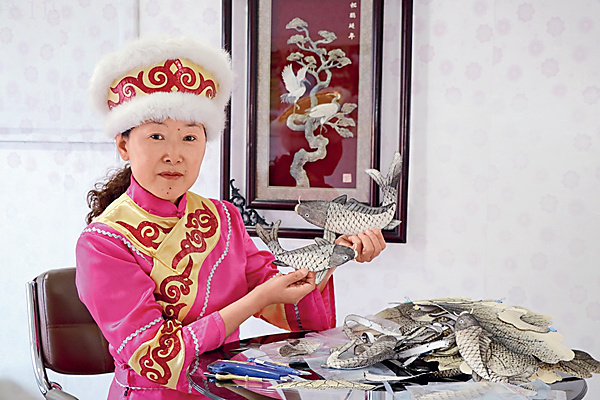 |
Wang Guirong |
Wang Guirong, a fish-skin painter in Fuyuan, a city in Heilongjiang, has been dedicated to inheriting and promoting the time-honored craft. She was named a provincial-level representative inheritor of the fish-skin craft in October 2016.
"I grew up by the river, and I have been familiar with various fish since childhood. My mother is ethnic Hezhen, and when I was little, she often made fishskin clothes for my sister and me," Wang recalls.
In December 2016, Wang established Mibi Hezhen Craft Studio, where she began accepting apprentices, free of charge. The studio primarily focuses on creating products to sell to tourists, such as fish-skin paintings, clothing, ornaments and decorations.
Wang says there are no shortcuts in creating fish-skin artworks. "Each step requires a certain level of skill and patience, as well as a significant investment of time. To create high-quality works, the most important thing is to stay calm and focused, and constantly refine your skills," she says.
"Different types of fish skin can endow artworks with distinctly different qualities. Artworks made from snake-head fish skin possess an elegant, ink-wash painting-like charm, while salmon skin gradually turns yellow over time, adding a unique appeal," Wang says. Through a dazzling array of fish-skin creations, Wang has breathed new life into the ancient craft once on the brink of extinction.
One of her most cherished creations is Auspicious Bliss, a fish-skin ornament crafted over 30 days with 20 pieces of fish skin. During creation, Wang meticulously numbered and precisely assembled each piece according to the design. She ensured natural alignment of the grain patterns, and harmonious color transitions, and she ultimately shaped each piece through a combination of adhesive bonding and stitching.
Upholding tradition while embracing innovation is the essence of Wang's approach to preserving intangible cultural heritage. "I have improved the craft and turned fish skin into various handicrafts, such as flowers, vases, and 3D architectural models. I also integrated cloisonné enamel techniques and 3D printing with the craft to create an innovative 3D, fish-skin cloisonné vase. The vase won the gold medal at the 2025 national tourism souvenir competition," Wang says.
Her studio has received strong support from Fuyuan Women's Federation. The federation has equipped the studio with computers, printers and office desks, and it has helped organize inheritors to participate in training, exhibitions and other activities.
"In particular, the federation has arranged for intangible cultural heritage inheritors to provide training in fish-skin painting, paper cutting and other handicraft skills to rural enthusiasts in nine townships. I also lead inheritors of my studio in organizing activities that bring fish-skin craft into communities, schools and scenic areas. To date, I have provided free training to more than 2,000 people," Wang says.
In recent years, Fuyuan has vigorously developed the "Hezhen Fish-Skin Painter" labor brand, and has expanded its product range to five major categories, including fish-skin paintings, fish-skin apparel and fish-bone art, comprehensively showcasing the allure of Hezhen fishing and hunting culture.
Wang has exhibited her fish-skin artworks at major events, including the China International Tourism Commodities Fair and the Harbin International Economic and Trade Fair.
She has also participated in cultural exchanges between China and Russia. In 2017 and 2018, she was awarded the titles of City Artisan and City Craftsman by the Khabarovsk City Government in Russia, for showcasing the beauty of China's outstanding traditional culture to the world.
For her relentless efforts in preserving and promoting the fish-skin craft, Wang has been named a Heilongjiang Provincial March 8th Red-Banner Holder and Heilongjiang Craftsman. "The path of intangible cultural heritage inheritance is long and arduous, but safeguarding ethnic culture is a lifelong pursuit worthy of wholehearted dedication," Wang says.
Photos from Interviewee
(Women of China English Monthly February 2026)
Editor: Wang Shasha