"You throw a quince (mugua) to me, I give you a white jade for friendship." Who would ever have guessed that line, from an ancient Chinese poetry collection, The Book of Songs, would one day play a role in the establishment and naming of an association dedicated to promoting Chinese culture in France?
The Sino-French Cultural Exchange Association Mugua, or Association Mugua for short, is a nonprofit organization dedicated to promoting Chinese culture in France. The association was established in 2022, and it was named after the above-mentioned line. The association's name was taken from that line because the line reflects the mutual nature of cultural exchanges, as the association's primary aim is to enhance cultural ties between China and France. During the past three years, the association has organized numerous events across France, each with the purpose of showcasing traditional Chinese culture. The activities have attracted, combined, thousands of participants.
Love for Hanfu
"May more people appreciate our Chinese culture." That is the shared aspiration of all Association Mugua members. The association's rise to prominence is the result of the persistence of several young Chinese, living in France, who love hanfu (traditional Chinese attire) culture.
Liu Jing, president of Association Mugua, moved to France for studies in 2019. Her connection with hanfu began when she was an undergraduate student in China. By chance, she attended a hanfu showcase on campus. "The organizers let us try on hanfu, and they taught us traditional games, like touhu (arrow-throwing) and feihualing (poetry recitation)," Liu recalls. "I not only experienced the beauty of hanfu, but I also realized such events allowed more people to experience traditional Chinese culture."
While studying in France, Liu, and many of her Chinese classmates, who shared her love for hanfu, often wore hanfu around campus, and on the streets of Paris. They wanted to proudly display traditional Chinese attire. Liu quickly noticed many of the locals were curious. The locals admired the Chinese fashions, and they would often stop her to ask questions about hanfu. Liu patiently explained the historical background of hanfu. Such experiences made her ask herself: "What can I do to spread awareness of hanfu and its cultural background to more people?" Liu decided to organize activities to display hanfu.
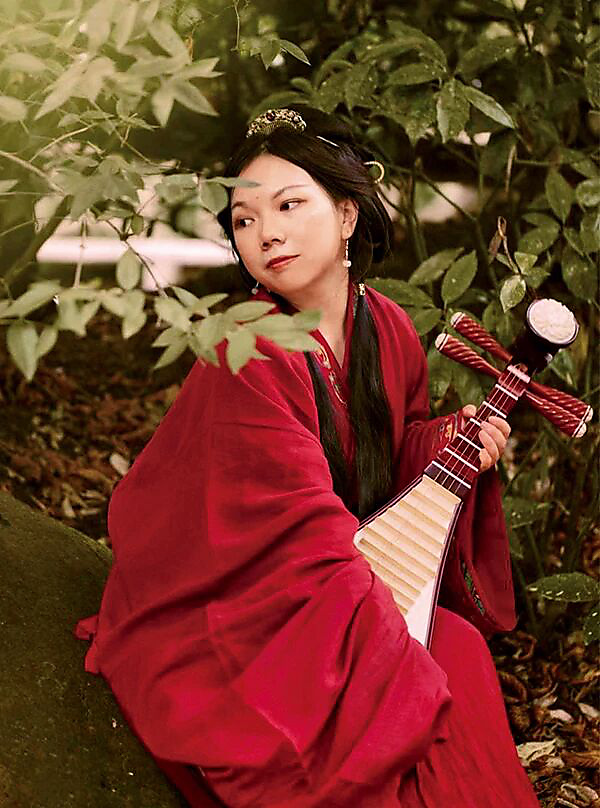 |
Liu Jing, President of Association Mugua |
Wanting to share their love for hanfu with others, Liu and several of her classmates established Association Mugua in 2022. "We started with only a dozen members. Now, we have more than 100, including Chinese students, overseas Chinese and French locals," Liu says. "At first, our members brought their own hanfu for the association's events. Later, we purchased more from China. Now, we have more than 100 sets, in various styles, used for exhibitions, workshops and performances."
In February 2023, Association Mugua organized a hanfu show as part of the Spring Festival gala for Chinese students. The event was hosted by the Union des Chercheurs et des Etudiants Chinois en France (UCECF). The show traced the evolution of hanfu, presented China's millennia-old clothing culture to more than 1,000 Chinese and French spectators, and showcased the younger Chinese generation's love and inheritance of traditional culture. "After the performance, the audience erupted in prolonged applause," Liu recalls. "Many French spectators said they were deeply impressed by Chinese culture, while our compatriots felt proud of our historical civilization."
Cultural Charm
The association brings like-minded people together to showcase the charm of ancient, and inclusive, Chinese culture through diverse, youth-oriented approaches. Activities are held during traditional Chinese festivals, including Spring Festival, Dragon Boat Festival, Qixi Festival (Chinese version of Valentine's Day), Mid-Autumn Festival and Chongyang Festival (festival to show respect and care for the elderly). The activities include dance performances, lectures and workshops on traditional Chinese crafts, featuring hanfu, calligraphy, tea art, dance and folk music.
In July 2023, members of the association performed the classical dance, Blossoms, during the opening ceremony of the Paris Asian Cultural Festival. The dance, which combined elegant movements with the charm of hanfu, interpreted the beauty of Chinese culture. "We rehearsed repeatedly to perfect Blossoms on stage," Liu says. "Despite the sweltering heat, everyone persisted, out of a desire to showcase Chinese culture beautifully. Their dedication was truly touching."
The association also set up a booth, to promote Chinese crafts and folk-music performances, and the booth attracted many visitors. One young girl caught Liu's attention. "At the cultural festival, a French girl spent a long time playing with the Luban lock (a traditional Chinese puzzle) at our booth," Liu remembers. "The various Chinese crafts, Chinese chess and Luban locks were among the highlights of the event. Their interactivity allowed visitors to experience the unique charm of traditional Chinese culture." The booth also attracted many Chinese children who were born and raised in France. "Parents talked with their children about the games they played as kids, and they found resonance at the booth," Liu says. "This helped enhance the children's sense of identity, and their belonging to Chinese culture."
Last year, during Mid-Autumn Festival, the association not only hosted a gathering in Paris's Luxembourg Gardens, but also set up a hanfu and tea-culture booth at the Confucius Institute, in Pau (in southwestern France). The association also collaborated with Galeries Lafayette, in Paris, to share the cultural background of Mid-Autumn Festival and various Chinese legends, including "Chang'e Flying to the Moon," with locals.
In February 2025, to celebrate the first Spring Festival after the Chinese holiday was added to UNESCO's Representative List of the Intangible Cultural Heritage of Humanity, a parade was held on the Avenue des Champs-Elysees. Members of Association Mugua participated, parading in hanfu, and they drew the attention of both locals and tourists, who clamored to take photos of the hanfu-clad marchers. Avenue des Champs-Elysees, which is 100 meters wide in places, was packed with spectators. Liu was heartened by the admiring looks from the bustling crowd. "In recent years, hanfu has gained increasing popularity and recognition overseas," she says.
This year, to celebrate Spring Festival, Association Mugua organized another hanfu formation during the Avenue des Champs-Elysees parade, on February 1, 2026. The association added the traditional yi dance (court dance), and elements of classical dances from the Han (206 BC-220 AD) and Tang (618-907) dynasties, to showcase more elements of Chinese culture. The association's members also showcased China's Spring Festival culture — in town halls, universities, primary and secondary schools, cultural institutions and commercial centers — across France.
Promoting Exchanges
"As Chinese who live overseas, we hope to showcase more of traditional Chinese culture, and we hope to help the French gain a better understanding of China," Liu says. "We want to be cultural envoys, and to change the many stereotypes about China."
In recent years, Association Mugua has established partnerships with UCECF, the Chinese Department of National Institute of Oriental Languages and Civilizations, and the Confucius Institute, in Nice (on the French Riviera, the southeastern coast of France). The association's members have organized numerous cultural activities, which have greatly enhanced young French people's understanding of traditional Chinese culture. The activities have also promoted Sino-French cultural exchanges.
Members of the association have also visited local primary schools, to teach Chinese calligraphy and fan painting. "Many French students learn Chinese at school, and they say the activities help them see the culture behind the language, which in turn helps them increase their interest in learning," Liu says.
Of the association's activities, Liu says the performances and workshops are among the most popular. "Hanfu shows, dances and folk-music performances produce excellent effects, as people can directly enjoy the visual experiences. Workshops allow people to participate in creation, and take home their works as souvenirs," Liu explains. "For example, we held events, during which participants made hairpins and fans, to help people understand Chinese culture, while unleashing their creativity. Many people took photos with their handmade crafts after the activities."
What does the association plan for the future? "We hope to open a dedicated Chinese-culture experience center, where hanfu, tea art, incense art and traditional crafts can be displayed permanently," Liu says. Additionally, she hopes to revitalize traditional Chinese culture with the innovative aesthetics of Chinese youth. For example, the association has already begun arranging Chinese folk and pop music — including TV drama and game theme songs — to appeal to younger listeners.
As Association Mugua becomes better known, more young French people want to join. "At first, most French members were students studying Chinese culture. Now, many are attracted by our cultural activities, and they want to participate," Liu says. "French college students have sent us resumes, hoping to assist with event planning. We believe more and more people will discover the charm of Chinese culture."
Photos from Interviewee
(Women of China English Monthly February 2026)
Editor: Wang Shasha