When light shines on exquisite lacquer work, inlaid with mother-of-pearl, the shells produce unique light and shadow effects, like flowing rainbows. Such a charming work of art combines lacquer, a natural resin, and mother-of-pearl inlay (also known as luodian), a traditional decoration technique involving iridescent shells. Jishan-style mother-of-pearl-inlaid lacquerware, which originated in ancient times in Jishan, a county in Yuncheng, a city in North China's Shanxi Province, is the crown jewel of traditional Chinese artworks.
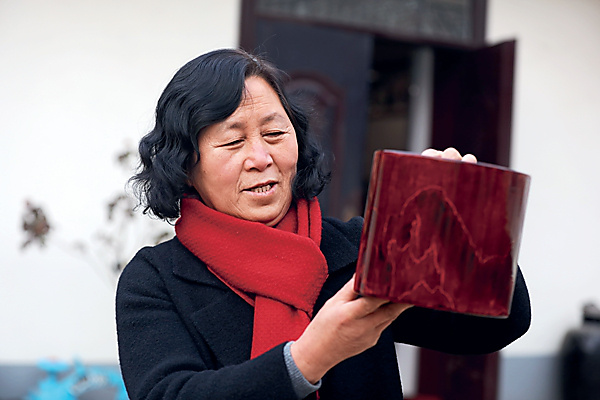 |
| Li Aizhen, a national-level representative inheritor of the decoration technique of Jishan-style mother-of-pearl-inlaid lacquerware |
Millennia-Old Craft
China is widely regarded as the country that discovered lacquer sap, from lacquer trees, and as the first country to utilize natural lacquer. Chinese lacquer art dates back nearly 8,000 years. The sticky lacquer sap is white when it is tapped from the tree. After it is exposed to oxygen and humidity, the sap hardens, or polymerizes, to become a natural plastic. Lacquer is remarkably resistant to water and some acids, and it can withstand heat, making it an ideal protective coating.
Mother-of-pearl is an ideal decorative material, given its texture and pearly luster. In ancient China, it symbolized prosperity and wealth, giving mother-of-pearl decorations auspicious meanings. Therefore, mother-ofpearl inlay is a traditional decorative art form in China.
The combination of lacquer and mother-of-pearl can be traced back nearly 3,000 years. During the Shang and Zhou dynasties (1600 BC-256 BC), artisans began decorating lacquerware with shell pieces. Lacquerware inlaid with mother-of-pearl reached its golden era during the Tang Dynasty (618-907). During that time, the works were not only exquisite in shape, but also superb in craftsmanship. The current decoration technique of Jishan-style mother-of-pearl-inlaid lacquerware was derived from the technique used during the Tang Dynasty.
The Ming (1368-1644) and Qing (1616-1911) dynasties became the heyday of mother-of-pearl-inlaid lacquerware. During those dynasties, a large number of lacquerware artisans earned their living in Jishan. However, Jishan's lacquerware industry began to wane in the later years of the Qing Dynasty. The decoration technique was nearly lost by the early 20th century.
Jishan Arts and Crafts Factory was established during the 1970s, to gather the remaining artisans who were able to make lacquerware inlaid with mother-of-pearl, and to prevent the endangered decoration technique from being lost forever.
In 1986, Li Aizhen, a former artisan at the factory, established a lacquerware factory (predecessor of Jishan Fanggu Tourist Crafts Factory) to continue to protect, inherit and innovatively develop the decoration technique of mother-of-pearl-inlaid lacquerware. "At that time, the lacquerware factory only had three artisans who were able to soften the shells (an essential step during the lacquerware-making process). I felt obligated to pass down the traditional technique to the next generation," recalls Li.
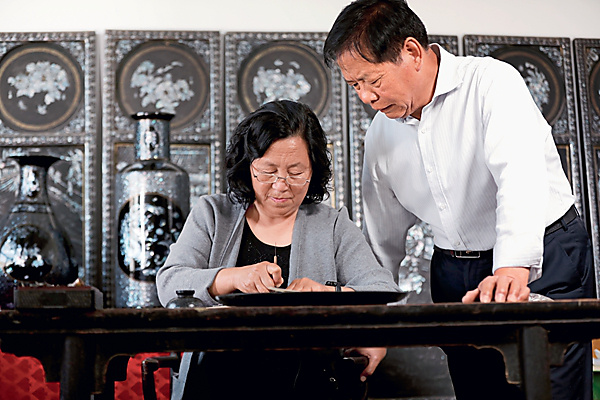 |
| Li Aizhen and Ma Guitang |
Exquisite Skills
The technique of mother-of-pearl inlay is divided into hard inlay and soft inlay. The hard inlay uses thick, simple-processed shell pieces. In contrast, soft inlay uses very thin shell slices. The slices are carved into various shapes, and they are finely inlaid on the lacquer base, presenting a dazzling effect.
Soft inlay is widely used in the process of making Jishan-style mother-of-pearl-inlaid lacquerware. The process can be described as complex and challenging. Dozens of steps — including selecting shapes, making the lacquer base, carving, inlaying, lacquer coating and polishing — are required. Some skilled artisans take several months, or even several years, to complete such delicate works of art.
Carving, inlaying, lacquer coating and polishing are vital steps during production. The artisan uses an engraving knife to carve thin shell slices (less than 0.1 millimeter thick), in different shapes, which requires expert painting skills and meticulous carving skills. Then, he/she accurately embeds the slices of shells into the lacquer base, to form the patterns or decorations. Later, a thick layer of lacquer will cover the lacquer base. The lacquer layer will be refined, repeatedly, to ensure the mother-of-pearl decorations are highlighted perfectly. Finally, the lacquerware surface will be polished, until perfectly smooth.
The decoration technique of Jishan-style mother-of-pearl-inlaid lacquerware is a brilliant example of traditional Chinese craftsmanship. The decoration technique was added to the list of China's national intangible cultural heritage in 2014.
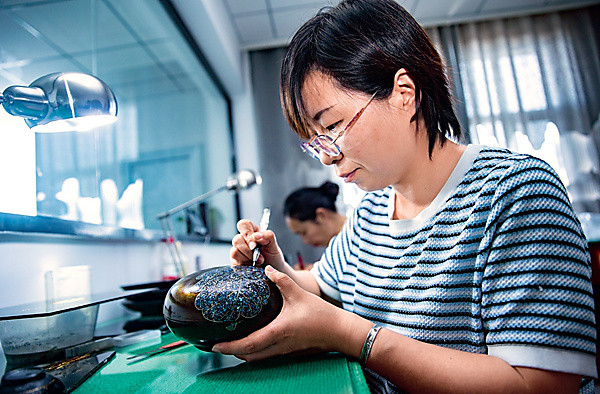 |
| Ma Jing, a provincial-level representative inheritor of the decoration technique of Jishan-style mother-of-pearl-inlaid lacquerware |
Inheritance, Innovation
Li began learning to make mother-of-pearl-inlaid lacquerware in 1976. Li married Ma Guitang in 1980. Liu Lanju, Ma's mother and a local lacquerware craftswoman, studied the skills of making mother-of-pearl-inlaid lacquerware, under her father, when she was young. Liu shared what she had learned about mother-of-pearl inlay to her daughter-in-law.
Ma began learning this traditional craftsmanship in 1984. He learned lacquerware-making skills from elderly craftspeople. Li shared her experiences, of making mother-of-pearl-inlaid lacquerware, with her husband, which helped Ma improve his skills.
Both Li and Ma believe in "adhering to traditional skills without being confined by it." The couple insist on using traditional methods to extract natural lacquer, and to make the slices of shells. Yet, they have made some innovations, including mixing lacquer with shell powder, to make the lacquer base, and softening the slices with white vinegar or radish juice. As for pattern design, they have innovatively used traditional porcelain patterns for reference.
Ma Jing, Li and Ma Guitang's daughter, studied lacquerware-making skills under her mother. In recent years, Ma Jing has developed mother-of-pearl-inlaid lacquer products — with aesthetic, fashionable elements — in an innovative way. She has made lacquer earrings, bracelets, bookmarks, car hangers, tea sets and incense burners, all inlaid with mother-of-pearl, to share the charm of lacquer art with as many people as possible.
All three members of the family are inheritors of the Jishan-style mother-of-pearl-inlaid-lacquerware decoration technique. Li is a national-level representative inheritor, while the Mas are provincial-level representative inheritors. They have worked together to cultivate a new force in the lacquerware industry, through various channels. They have cooperated with colleges to set up internship bases for college students.
Li and Ma Jing have promoted lacquerware-making skills among dozens of migrant women, who have returned to their hometowns in Jishan area. Ma Jing also established mother-of-pearl-inlaid lacquerware courses at Jishan Vocational School.
"The intangible cultural heritage is not only a record of history, but also hope for the future. Driven by Guochao (a consumer trend, translated as "China-chic"), mother-of-pearl-inlaid lacquerware is making its way to the world, becoming a cultural bridge connecting the past and the future," Ma Jing says.
Photos from Interviewees
(Women of China English Monthly December 2025)
Editor: Wang Shasha