 |
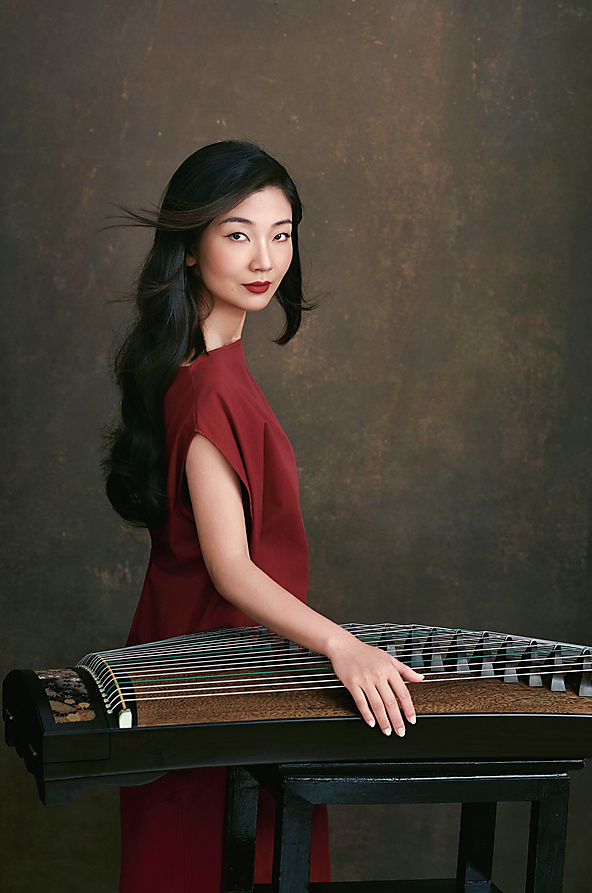
| He Beibei, also known as Bei Bei Monter, is a Los Angeles–based virtuoso guzheng and guqin artist, composer and recording artist. [Photo by Liu Shuying] |
He Beibei, also known as Bei Bei Monter, is a Los Angeles–based virtuoso guzheng and guqin artist, composer and recording artist. As one of the premier guzheng musicians in the United States, she has played an exceptional role in introducing this ancient Chinese instrument to audiences around the world. More remarkably, she has built a musical bridge between East and West through her distinctive and innovative approach to guzheng performance.
Musical Beginnings
Bei Bei, who was born in Chengdu, capital of Southwest China's Sichuan Province, began studying the guzheng at 6. Six years later, she was admitted to the music department's preparatory program at Minzu University of China, in Beijing.
At 18, she enrolled in Hong Kong Academy for Performing Arts, where she majored in both guzheng and theater sound design, minored in guqin, and also studied composition. During her time at the academy, she developed the idea of blending jazz with guzheng music — a concept that would later become one of her artistic hallmarks.
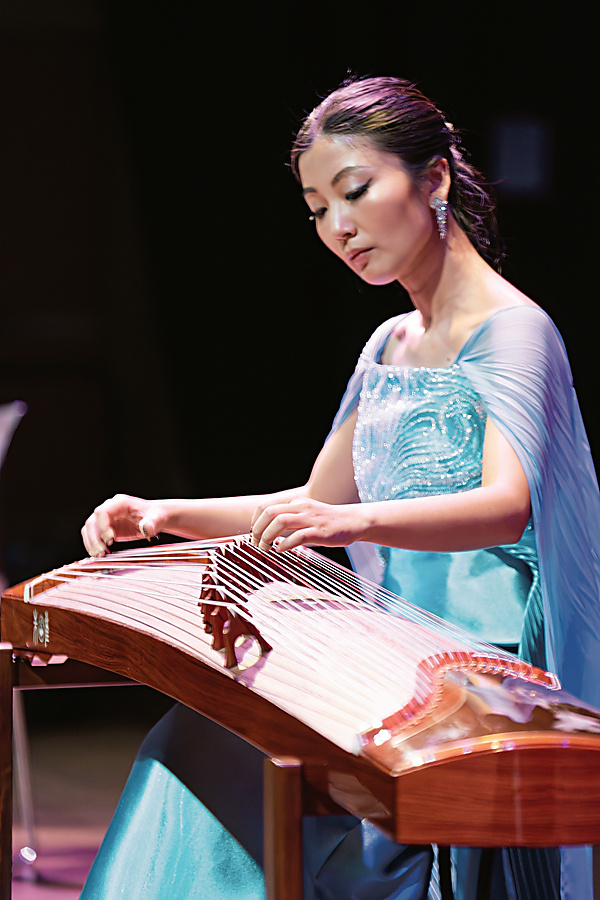 |
| As one of the premier guzheng musicians in the United States, He Beibei has played an exceptional role in introducing this ancient Chinese instrument to audiences around the world. [Photo by Simon Wang] |
Bei Bei's eyes sparkle as she recalls her first encounter with guzheng. "I was captivated by its beautiful and enchanting tone the first time I heard it. I've loved it ever since," she says. Years of disciplined, repetitive practice gradually turned into melodies in her hands — sometimes as gentle as the moonlight, and sometimes as powerful as a rushing river, but always carrying a quiet strength within their softness.
In 2003, Bei Bei moved to the US to further her studies in Music Recording at Azusa Pacific University and Citrus College, as well as jazz performance at Fullerton College, all in California.
Determined to expand her artistic boundaries, Bei Bei began exploring new possibilities for the guzheng. "Whatever I feel in my heart, whatever emotional state I'm in, I express it naturally," she says. Once she freed herself from the rigid conventions of classical performance, she began allowing her emotions to guide her hands, letting her thoughts and perceptions flow freely through her fingertips into her melodies.
For Bei Bei, improvisation is not merely a display of skill; it is a dialogue with her soul. "Inspiration sparks in an instant; yet, it is rooted in genuine emotions that rise from deep within," she explains. "Of course, achieving a successful improvisation requires not only inspiration, but also courage, confidence and unwavering focus."
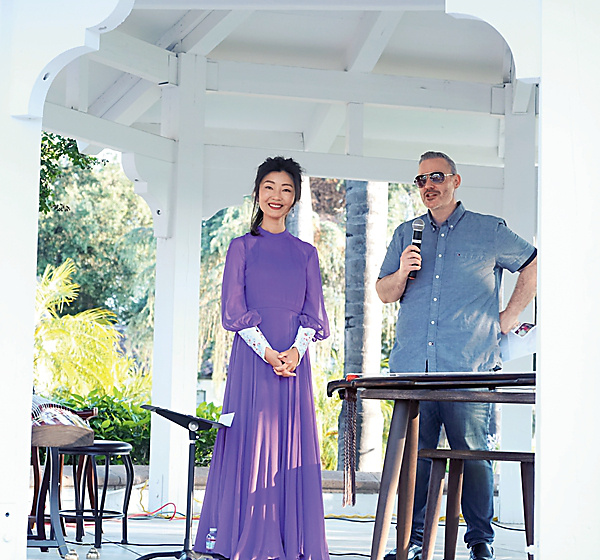 |
| He Beibei (left) attends an outdoor concert. [Photo by Jing Wang] |
Melodies Help Connect World
After moving to Los Angeles, Bei Bei found herself reflecting deeply on a new question: How can the guzheng radiate fresh vitality on the global stage? The answer gradually emerged through her reflections and through her collaborations with musicians from diverse cultural backgrounds.
"Rather than merely using the guzheng to imitate Western music, we should strive to create a profound spiritual resonance," Bei Bei explains.
In 2017, she and composer Adam Gilberti co-wrote Rhapsody of Water and Fire, a concerto for guzheng and symphony orchestra. The "water" section draws upon the the traditional Chinese aesthetic of "flowing clouds and running water," and expressing tranquility through fluid, lingering tones. The "fire" section, by contrast, incorporates jazz rhythms to build dramatic tension.
Through the improvisational interplay between the guzheng and the organ, the piece symbolizes the deep fusion of Eastern and Western musical languages.
The concerto seamlessly bridges East and West, classical and jazz, water and fire — embodying the artists' cross-cultural vision and the boundless potential of music as a universal language that seeks harmony in diversity.
Bei Bei's performances extend beyond concert halls into film and television. In 2019, she performed on the soundtrack of Disney's live-action Mulan, contributing to the main theme Loyal, Brave and True.
Bei Bei says she was profoundly moved by Mulan's loyalty, courage and authenticity — qualities she sought to embody through her guzheng performance. The spirit of Mulan continues to inspire her: To stay true to her passion, face challenges with bravery, and pursue growth with honesty while continually exploring her artistic potential.
Her recording work also includes contributions to the Kung Fu Panda 4 soundtrack, as well as numerous cross-disciplinary collaborations blending music, dance and visual art.
On her album Into the Wind, the track The Blue Grotto captures the graceful elegance and ethereal beauty of the flying apsaras in the ancient Dunhuang murals in Northwest China's Gansu Province.
"The piece is a musical tribute to Dunhuang," Bei Bei says. "When I visited the Mogao Grottoes, in Dunhuang, in 2008, I was deeply moved by the sculptures, murals, and the vast, majestic beauty of the desert. I've always longed to convey that feeling through music."
In The Blue Grotto, Bei Bei evokes the vastness of the desert through sweeping melodies and portrays Dunhuang's millennia-old brilliance with shimmering, ethereal tones — allowing listeners to sense the echoes of civilization and the enduring power of culture through her music. Celebrated as a pioneering folk artist, Bei Bei has developed a distinctive creative style. Influenced by multicultural encounters, she firmly believes the more she performs on the global stage, the more deeply she must remain rooted in Chinese culture.
Wider Audience
Sharing the sound of the guzheng with the world has always been Bei Bei's original and unwavering aspiration. In addition to performing on stage, she teaches at her studio, offers community workshops, and organizes student concerts and showcases.
Bei Bei believes every plucked string and every performance plants a cultural seed — one that can sprout among listeners of diverse backgrounds and help Chinese music flourish across the world. To her, the guzheng is no longer just an ancient Eastern instrument; it has become a bridge that connects cultures.
In 2007, Bei Bei established her own guzheng academy in Los Angeles. Most of her students are of Asian, particularly Chinese, heritage. Through stage performances and community events, their connections with the Chinese community have grown stronger. The process has not only deepened their cultural identity, but has vividly shared the beauty of Chinese art with audiences abroad.
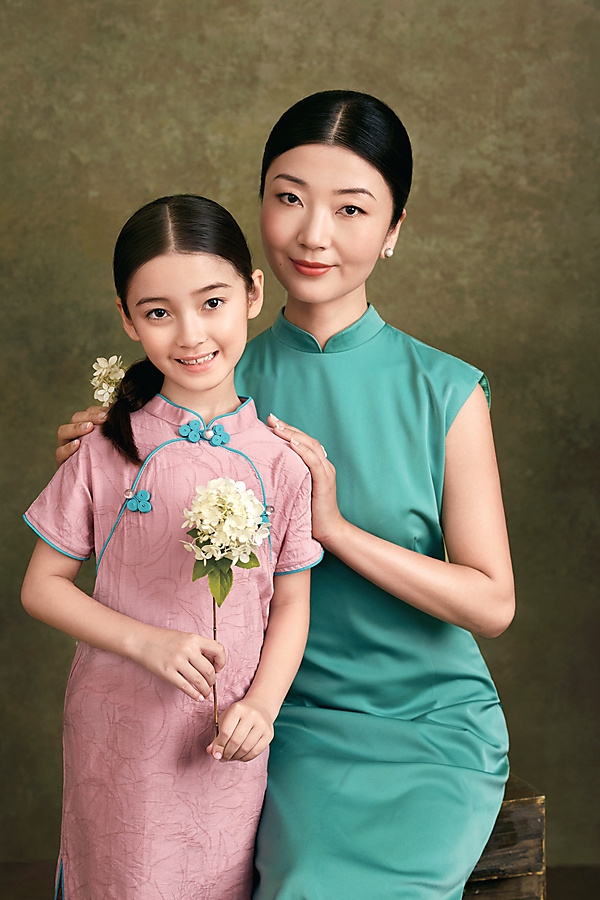 |
| He Beibei and her daughter [Photo by Liu Shuying] |
Bei Bei is equally devoted to nurturing her daughter's cultural identity. "My daughter has been learning Chinese dance. She was born in the US. I hope she not only masters Chinese, but also experiences and appreciates the beauty of Chinese culture, through the rhythm of Chinese classical dance, and even the martial arts she has recently become fascinated with," Bei Bei says. "Chinese culture and art are profound and far-reaching. The more one understands, the broader one's perspective on life becomes. This is not just about acquiring skills; it's about strengthening the emotional bond between us, as mother and daughter, and between her and her cultural heritage."
Many of Bei Bei's students choose to perform her original compositions at community events. "Their love for playing my works is the most gratifying reward for me, and a true resonance on my artistic journey," she says.
In 2017, Bei Bei was invited to teach during a guzheng workshop, organized by the Sino US Performing Arts Organization and Bowers Museum, introducing the instrument to American students.
"These experiences are just a starting point. Truly mastering the essence of traditional Chinese music takes time. But by planting cultural seeds, we hope participants will be inspired to attend guzheng concerts and continue their interest in traditional Chinese music," she says.
When asked what advice she would give to the younger generation, Bei Bei responds thoughtfully: "Stay open to all possibilities, and dare to try different things. Don't set limits on art, or yourself, in advance. Instruments, techniques and styles are just tools. The human being is the core of creation. True innovation often happens at the intersection of cross-disciplinary exploration. This process helps you understand yourself more deeply and, ultimately, discover your own unique voice."
In January, the Bei Bei Fusion Guzheng Concert and Original Works Showcase, organized by the East West Cultural Association of America, was held in Los Angeles. The concert blended jazz, blues, rock and electronic elements, featuring pieces such as The Blue Grotto, Ink, The Butterfly Lovers and Year of the Funky. Bei Bei also performed her rearrangement of Stayin' Alive by the Bee Gees, offering a fresh take that transcended both eras and cultures.
"This was not merely an auditory feast, but a profound cultural dialogue," said some members of the audience. The concert not only showcased Bei Bei's exceptional artistry, but also stood out as one of the year's most remarkable cross-cultural music events.
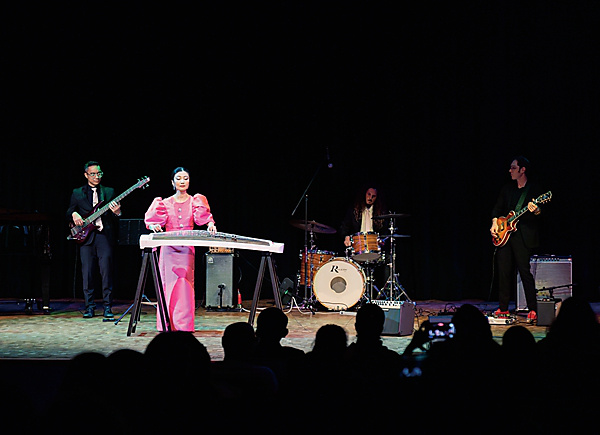 |
| He Beibei has built a musical bridge between East and West through her distinctive and innovative approach to guzheng performance. [Photo by Simon Wang] |
Musical Letter Home
Even overseas, in different languages and cultural environments, the familiar melodies, flowing from Bei Bei's fingertips, always guide her back to her homeland. The deep-rooted connection has always been her unwavering compass, no matter how far she has traveled from China. For Bei Bei, her music is like a heartfelt letter home.
In the near future, Bei Bei will release her new album Two Moons in collaboration with British musician Paul Elliott. The album features seven original tracks, including Silk Soiree, Shanghai Dreams and Gaoshan Electronica. Through this project, Bei Bei aims to present fresh expressions of Chinese musical elements within a modern, global soundscape.
Two Moons was inspired by the night of the 2024 Mid-Autumn Festival. As Bei Bei gazed at the full moon and its reflection, a wave of memories surfaced — of Mid-Autumn Festival gatherings, Spring Festival reunions, and holidays spent apart from family. A swirl of feelings — freedom, tenderness, nostalgia and melancholy — all intertwined and flowed, and ultimately evolved into a poetic musical creation.
Gaoshan Electronica incorporates the dance rhythms of the Qiang and other ethnic minority groups, inviting listeners to move with the beat. As a descendant of the Qiang ethnic group, Bei Bei pays tribute to the "people above the clouds" through this vibrant "mountain song."
"What makes me proudest is hearing foreign audiences sincerely exclaim, 'So beautiful! Amazing!' after a performance," Bei Bei says. Her music leads concertgoers to a purer realm — a resting place, a spiritual homeland.
The guzheng has become a window that helps audiences see and understand Chinese culture. Bei Bei is the artist who opens that window. One end of each string connects the red walls and white snow of the Forbidden City; the other reaches across the Pacific, linking the glittering lights of distant cities. What binds them together is Bei Bei's enduring Chinese heart.
(Women of China English Monthly November 2025)
Editor: Wang Shasha