 |
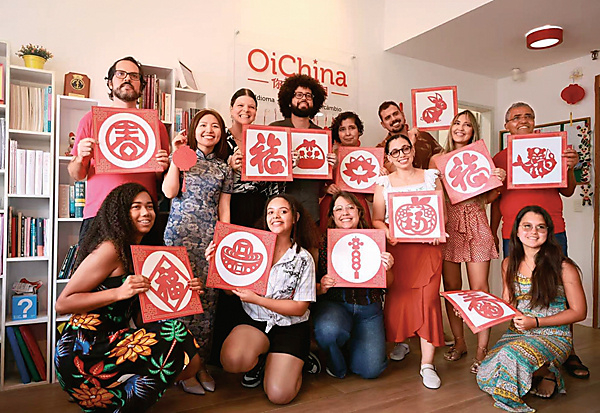
| Wang Yili (back, second from left) poses for a photo with students from Hello China Chinese-language school. |
China and Brazil issued a joint announcement in March, to celebrate 2026 China-Brazil Cultural Year, and that announcement sparked considerable discussion among overseas Chinese in Brazil. During their daily lives and work, overseas Chinese in Brazil have forged deep bonds with the locals, through mutual and cultural understanding, and their bonds have served as a vivid footnote to China-Brazil friendship.
Scholar's Chinese Name
Evandro Carvalho, a Brazilian expert on China, and a professor with the Law School of Fluminense Federal University, in Niterói, in Rio de Janeiro State, in Brazil, has a Chinese name: Gao Wenyong. "When I visited China (during academic visits during recent years), many people called me Professor Gao, while some close friends called me Wenyong. This name feels very 'Chinese,'" he says.
In February 2024, Carvalho received the Chinese Government Friendship Award, for his outstanding contributions to promoting cultural exchanges between China and Brazil.
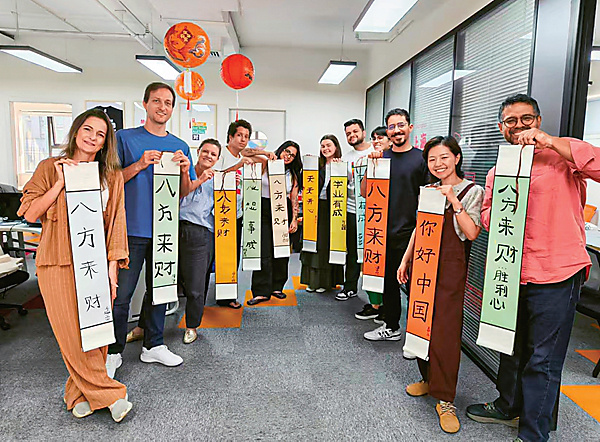 |
| Wang Yili (second from right) shows calligraphy works with students from Hello China Chinese-language school. |
"'Gao' is a phonetic approximation of the Portuguese surname Carvalho, 'Wen' (literally meaning culture or literature) refers to his professorial identity, and 'Yong' (literally meaning brave) represents the courage to learn Chinese," says Wang Yili, Carvalho's friend and former Chinese tutor.
Wang is familiar with the meaning behind her friend's name. In 2006, Wang's mother, Liu Xiaojuan, founded a Chinese-language school, Hello China, in Rio de Janeiro. After she graduated from Federal University of Rio de Janeiro, Wang began teaching at her mother's school. Most of the students were adults, from various professions. Carvalho was one of the students.
"As a law professor, his courage to learn Chinese, from scratch, was truly impressive. My mother helped him choose the Chinese name, Gao Wenyong," Wang says.
After he learned to speak Chinese, Carvalho made academic visits to China, he studied Chinese issues, and he participated in various China-Brazil academic exchanges.
The friendship between Wang and Carvalho continues. As a simultaneous interpreter, Wang interpreted for Carvalho, while he was a guest speaker, during several academic conferences.
"He has always followed China's development, and he has often shared with me the new changes and achievements he has discovered in China," Wang says. "Hearing the recognition of China, from Brazilian friends, makes me feel immensely proud, and more deeply aware of the significance of cultural exchanges."
In recent years, more and more young Brazilians, studying at the Chinese-language school, have developed a strong interest in China. Many Brazilians have even applied to study in China, and many have chosen careers in some way related to China.
Wang is also an Internet influencer, and she has about 2.6 million followers on overseas social-media platforms. "Living abroad, each of us represents China. When the world sees us, it also sees what China is like," Wang says.
She often posts short videos about China, including daily details to share Chinese cuisine, customs and developmental changes.
"In response to some netizens' prejudice against Chinese products, I recorded a video, in Portuguese, introducing 'Made in China' items, which are ubiquitous in the lives of Brazilians, and the video garnered over 12 million views," Wang says. "One insight I have gained is that telling China's story well requires not only making it understandable, but also presenting a true, multidimensional, and comprehensive China in the most accessible way."
Now, many netizens leave comments under Wang's videos, expressing their longing for China. Reads one comment: "A few years ago, I refused to go to China because of the differences between China and Brazil. Now, I am eager to explore it, precisely because of those differences."
Wang appreciates such comments. "China and Brazil are thousands of miles apart, but the people of both countries share a high degree of similarity — equally warm, hospitable, diverse and inclusive," Wang says. "I will shoulder the responsibility, and commitment, of the younger generation contributing to China-Brazil friendship, through the most-sincere communications."
Martial Arts Coach
"One, two, three, four ..." In the rehearsal room of Hua Xing Arts Group, in São Paulo, Marco Martin, a Brazilian martial arts coach, gives crisp, clear commands, in Chinese, as he guides his students through each move and posture.
"His heartfelt love for Chinese culture deeply touches everyone around him," Li Qingxia, head of the arts group, says of her partner.
In 2022, the arts group participated in a cultural performance, which was held in a rural area of São Paulo. Martin, who was one of the dragon and lion dance performers, stood out, given his skilled, and energetic, performance.
Martin's martial arts training contributed to his energy. Martin had been studying Choy Li Fut kung fu (a form of Chinese martial arts founded in 1836), under a Chinese-American master, since he was 7. Martin now owns a martial arts school, in São Paulo, and his school is well-known.
Every Chinese New Year, the arts group organizes flash-mob performances, which attract large crowds. After Li met Martin, in 2022, she invited him to participate in that year's flash mob.
Martin, and his disciples, performed martial arts, and the dragon and lion dance, and they injected new vitality into the celebration.
About a year later, the arts group established a martial arts class, and Martin became the resident coach. He teaches every Saturday and Sunday. "I have a predestined connection with Chinese people," Martin often says.
In 2024, the arts group planned to choreograph a drum-dance performance, but the group did not have a qualified drum-dance instructor. One day, while Martin played the drums, Li noticed Martin had a great sense of rhythm. She encouraged him to teach the drum dance.
Martin repeatedly studied videos of drum dances, and he downloaded relevant materials, to help him grasp the essence of the dance.
He combined Chinese charm and Brazilian characteristics when he choreographed Dragon Soaring and Tiger Leaping. The performance stunned the audience, and won the praise of many Brazilians.
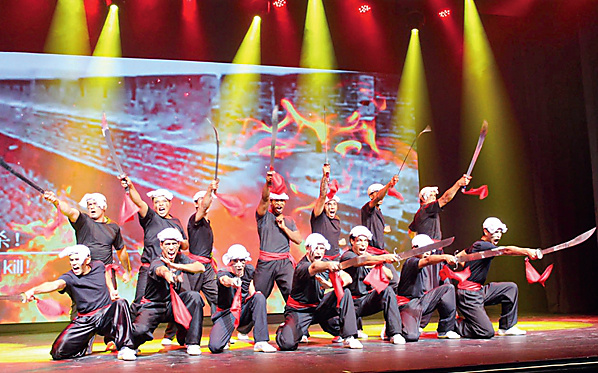 |
Marco Martin and his disciples perform the dance, Broadsword March. |
In 2025, the arts group helped organize a large-scale cultural performance to commemorate the 80th anniversary of the victory of the Chinese People's War of Resistance Against Japanese Aggression and the World Anti-Fascist War.
Martin led his disciples in choreographing a dance to Broadsword March, a Chinese song. On the day of the performance, more than a dozen Brazilian youths, wearing white headbands and red sashes, vividly showcased the boldness and strength of the dance. Their performance was one of the show's highlights.
"Martin's understanding of Chinese culture is profound. Every time we discuss performance details, we have a great rapport, and we quickly grasp each other's meaning," Li says.
This year marks China-Brazil Cultural Year, the 10th anniversary of the establishment of the arts group, and the 30th anniversary of the founding of the original — Huasheng Arts Group — organization. Huasheng Arts Group, founded by Li in 1996, was renamed Hua Xing Arts Group in 2016.
In recent months, Hua Xing Arts Group has been preparing for several performances, and the performers of Galloping Steeds, the drum dance being choreographed by Martin, have been under a rigid rehearsal schedule.
"We will integrate Chinese and Brazilian cultural elements into the program. We look forward to artists, from both countries, performing on the same stage, to create even more brilliant sparks," Li says.
Filmmakers' Mutual Efforts
In 2019, during an exchange event, which focused on Chinese and Brazilian culture and the audiovisual industry, Chen Xiangguang, general manager of Kangqiao Bozhi Cultural Media Company, met Hélio Pitanga, a Brazilian documentary producer and director.
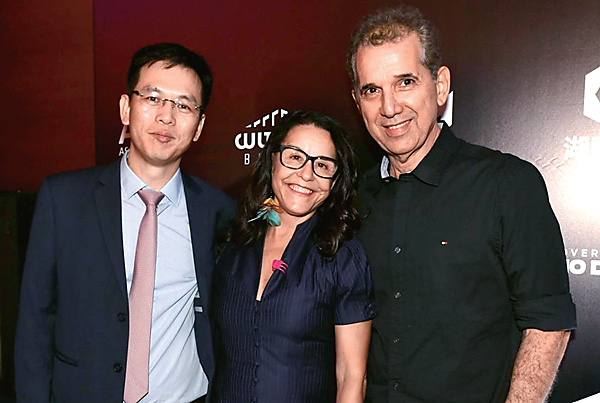 |
The fourth China-Brazil Film Festival was held in August 2025. |
"From our first meeting, Pitanga left a deep impression on me: Professional and dedicated," Chen recalls.
At that time, Chen was thinking about organizing the first China-Brazil Film Festival. When Chen shared his idea, Pitanga said he was "very interested" in it. "We both had a desire for long-term cooperation. This mutual understanding made me believe we could work together to establish and sustain the film festival," Chen says.
Soon, Chen and Pitanga began organizing the film festival, and they were talking about establishing film and television exchanges between the two countries. Since 2019, the festival has been held four times, and it has screened more than 30 outstanding films from both countries.
In August 2025, the fourth China-Brazil Film Festival included a China-Brazil Youth Short Film Exchange section, which focused on new technologies, new perspectives and new youth. That section opened a window for exchanges between young short-film makers from the two countries.
As their cooperation deepened, their friendship grew stronger. "We discuss everything, from narrative styles and aesthetic concepts to film creation and industry operations. Our exchanges have become increasingly candid," Chen says. Films, he adds, have built a bridge for both people-to-people connectivity and mutual cultural learning between China and Brazil.
Chinese films — with increasingly diverse themes, ranging from visually stunning sci-fi blockbusters, realistic works addressing contemporary issues to high-quality animated films rooted in traditional Chinese culture — have expanded their global reach in recent years.
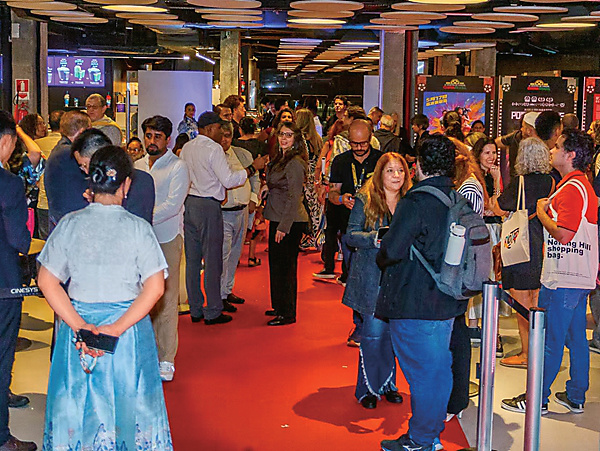 |
| Chen Xiangguang (left) and Hélio Pitanga (right) pose for a photo with a Brazilian actress at the China-Brazil Film Festival. |
The richness of Chinese film's narratives, the adherence to historic heritage and Eastern aesthetics, and the profound expression of collectivism and traditional culture have caught the attention, and interest, of Brazilian filmmakers, Chen says. This has contributed to Chinese filmmakers' confidence when they are promoting their films overseas, he adds.
Chen has gained a deeper understanding of Brazilian film culture through exchanges with his Brazilian peers, including Pitanga. "Brazilian culture is full of creativity, inclusiveness and diverse charm. Brazilian films naturally carry a warm, yet powerful, narrative style, blending humanistic care with emotional tension," Chen says. "A film is like a window that allows different lifestyles to be seen and understood, giving local stories a global perspective, and bringing us closer through cultural understanding."
Chen and Pitanga are currently organizing the fifth China-Brazil Film Festival. "In the future, we will also promote implementation of co-production projects between the two countries, establish professional-exchange platforms through seminars and workshops, and deepen institutional cooperation, to make China-Brazil film and television exchanges more institutionalized and sustainable," Chen says.
Photos from Interviewees
Source: People's Daily Overseas Edition
(Women of China English Monthly June 2026)
Editor: Wang Shasha