 |
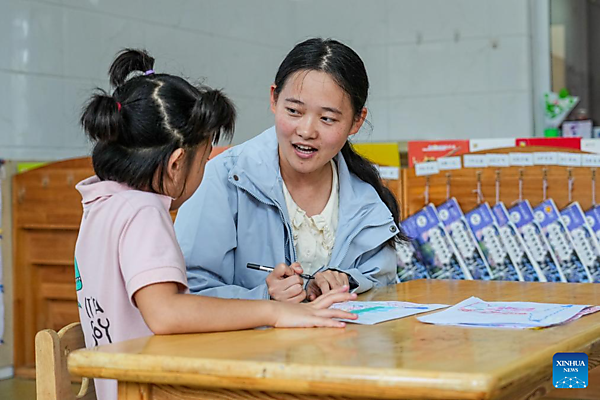
| A teacher talks with a child at the Special Education Experimental Kindergarten of Yinan County in the city of Linyi, east China's Shandong Province, Oct. 11, 2025.China is home to more than 85 million people with disabilities, accounting for about 6 percent of its total population. Disability-inclusive education ensures that students with disabilities learn alongside their peers without disabilities in mainstream settings — via the necessary support and accommodation. [Xinhua/Zhu Zheng] |
JINAN, Dec. 2 (Xinhua) — It was outdoor time and the playground at Special Education Experimental Kindergarten of Yinan County in the city of Linyi, east China's Shandong Province, was swarming with children. Nannan, 6, was one of them and could be seen running and laughing with her friends.
This scene has become so common that nobody can even notice that Nannan, like some other children at this kindergarten, is a child with an intellectual disability.
"Her change since entering the kindergarten has been tremendous," said Nannan's mom, Li Fa'ai.
Nannan was diagnosed with intellectual disability and autism when she was three years old. Her parents took her to many places for treatment, before Nannan was eventually sent to the inclusive class of this kindergarten last September.
"At first she didn't talk and could hardly sit still, while from time to time she lost her temper," Li recalled. During the past year, however, Nannan learned how to interact with her classmates and has shown an ability to understand simple instructions through games. Now she can even pass her mom plates when she cooks at home and has learned how to boil water for instant noodles.
Not Walking Alone
China is home to more than 85 million people with disabilities, accounting for about 6 percent of its total population.
Disability-inclusive education ensures that students with disabilities learn alongside their peers without disabilities in mainstream settings — via the necessary support and accommodation.
China has initiated inclusive education for decades, and achievements have been made in this aspect. However, many children, especially those with intellectual and developmental disabilities, still faced difficulties entering the same kindergartens or schools as their peers.
The China office of the United Nations Children's Fund (UNICEF) collaborated with China's education authorities to start the disability-inclusive education program at the end of 2022. To date, the program has covered roughly 1.1 million children at 1,682 schools and kindergartens in seven provinces and municipalities across China.
"Such practices help children with disabilities enhance their social adaptability and independent living skills, improve the social flexibility of other children, enable all children to learn better, build an inclusive society and reduce discrimination," said UNICEF education specialist Chen Xuefeng.
Many children in this program have intellectual and developmental disabilities. Therefore, some teachers expressed concerns about such practice at the start of this initiative.
Yang Jinlei, 42, is a teacher at the No. 2 Experimental Kindergarten of Yinan. She admitted that she was worried when disability-inclusive education was first introduced. "It had the potential to cause a lot of trouble. I was not confident that I could take care of everyone well."
A child named Dayu was the first with such specific needs to be sent to Yang's class in May last year. Dayu, a boy with autism, was not able to communicate or put on his own shoes when he first arrived. Yang taught him repeatedly, and gradually other children in the class also started to help Dayu with his shoes and in finding his locker.
One day, out of the blue, Dayu plucked a blade of grass during outdoor activities and gave to Yang. This act immediately made Yang feel that all her efforts with Dayu had paid off. "I was so touched," she recalled.
Dayu has reached a stage where he can almost take care of himself at the kindergarten. "Now I really see the advantage of disability-inclusive education," Yang said. "He couldn't have progressed so fast were he not in such a class."
Another teacher at this kindergarten, Liu Lele, 27, has 16 children in her class, including three with special needs. She remembered introducing Nannan to the other children and helping her in joining in the games they played.
Another autistic child in this class, Niuniu, queued up with other children at lunchtime and scooped rice and vegetables all by himself. Liu told Xinhua that Niuniu had gradually learned to do this from his classmates.
Bridging Their Differences
Notably, this project is also changing the attitudes of Niuniu's classmates and their families.
Niuniu is usually very focused, learning Chinese characters and reciting poems very quickly. He is also good at doing handicrafts, with the forklifts and cranes he made using plastic pieces on display in the classroom.
"Other children can now see his merits — and some even admire him," said 26-year-old teacher Fu Enrong. "Inclusive education has bridged the barriers of mainstream children and children with special needs."
Ren Jingyi's daughter is a friend of Nannan. "My daughter became more empathetic after entering kindergarten," said Ren. "She once told me that children came from different stars — and Nannan was from a lonely planet, as initially nobody spoke to her. My daughter then decided to take care of Nannan."
Song Ruxue's son, meanwhile, is in the same class as Dayu. At the beginning Song was concerned that her son would not be able to get on well with the children with special needs. But after more than about a year, she saw positive changes in him. "He has become used to protecting others and is becoming more brave. Also, my son is more patient now and has learned to put things away by himself."
During the 14th Five-Year Plan period (2021-2025), the enrollment rate of children and adolescents with disabilities in compulsory education in China has reached 97 percent — with over 30,000 students with disabilities entering universities each year.
China's next five-year plan is prioritizing high-quality development in the disability sector.
Tian Xiang, vice director of the education and sports bureau in Yinan, has revealed that a group of 107 teachers in this county are receiving disability-inclusive education training each month — and using their knowledge to help more teachers.
Results achieved by this kindergarten project are driving the participation of more institutions in such inclusive education. Statistics suggest that as of September 2025, a total of 502 kindergartens in Linyi had taken the initiative to carry out inclusive education and had admitted 1,155 children with special needs.
Li Fa'ai's biggest dream now is for Nannan to enter a public primary school next year. Since the start of this project, 12 children with special needs from Special Education Experimental Kindergarten of Yinan have been accepted by public primary schools, while in the case of No. 2 Experimental Kindergarten of Yinan, all four special children were accepted.
Zhang Chengjian, a researcher with the Linyi Academy of Educational Sciences, said that in May they had invited multiple departments including the county's civil affairs bureau, disabled persons' federation and health commission to visit these kindergartens and learn about the integration project — so as to promote the concept to primary schools and even higher education institutions. "It is our hope that the support of the whole society can ensure sustainable inclusive development of children until they have grown up," he said.
Principal of the Special Education Experimental Kindergarten of Yinan, Zhang Huandong, has been invited to give lectures to college students studying in the education field. "Hopefully, one day such kindergartens labeled as 'special education' will no longer exist — which would mean that we had truly achieved integration." Enditem
(Please note that pseudonyms have been used for children in this story to protect their privacy.)
 |
| A teacher talks with a child at the Special Education Experimental Kindergarten of Yinan County in the city of Linyi, east China's Shandong Province, Oct. 11, 2025. [Xinhua/Zhu Zheng] |
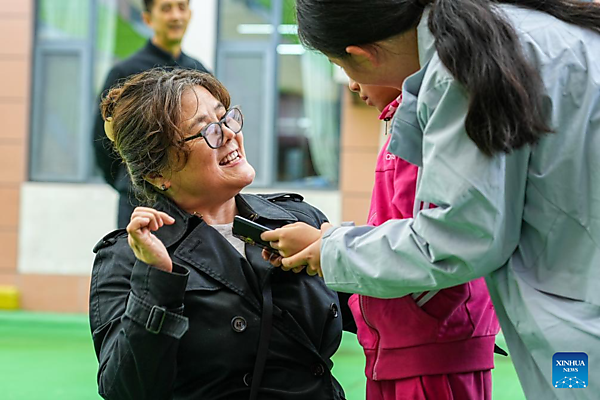 |
| Chen Xuefeng (L), an education specialist with the United Nations Children's Fund (UNICEF), talks with a child at the Special Education Experimental Kindergarten of Yinan County in the city of Linyi, east China's Shandong Province, Oct. 11, 2025. [Xinhua/Zhu Zheng] |
 |
| Children and teachers rearrange play facilities at the Special Education Experimental Kindergarten of Yinan County in the city of Linyi, east China's Shandong Province, Oct. 11, 2025. [Xinhua/Zhu Zheng] |
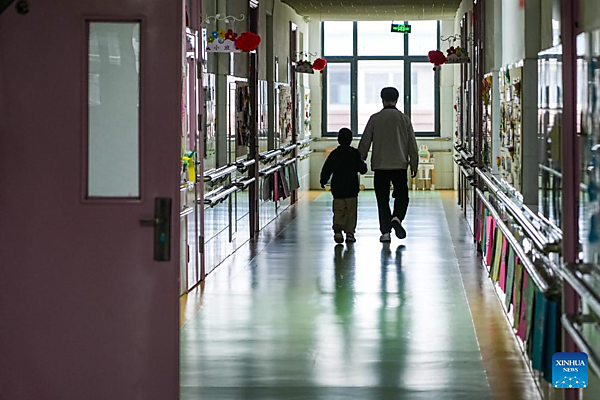 |
| A teacher walks with a child at the Special Education Experimental Kindergarten of Yinan County in the city of Linyi, east China's Shandong Province, Oct. 11, 2025. [Xinhua/Zhu Zheng] |
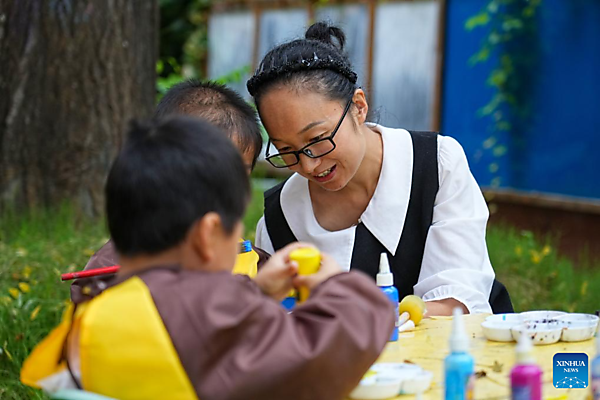 |
| A teacher instructs children on drawing at the Special Education Experimental Kindergarten of Yinan County in the city of Linyi, east China's Shandong Province, Oct. 11, 2025. [Xinhua/Zhu Zheng] |
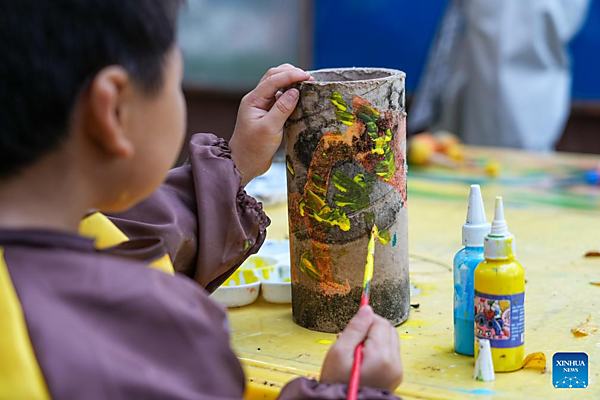 |
| A child paints at the Special Education Experimental Kindergarten of Yinan County in the city of Linyi, east China's Shandong Province, Oct. 11, 2025. [Xinhua/Zhu Zheng] |
(Source: Xinhua)
Editor: Wang Shasha