 |
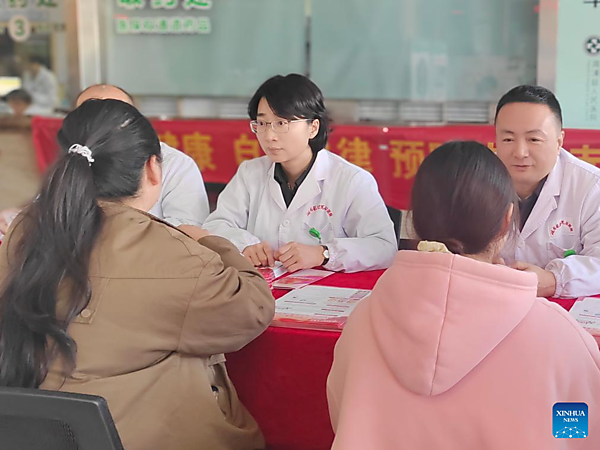
| Ouyang Yi, an infectious disease specialist from Xiangya Hospital, publicizes knowledge about HIV/AIDS in Huaihua, central China's Hunan Province, Dec. 1, 2024. [Xinhua] |
CHANGSHA, Dec. 1 (Xinhua) — When asked why she has been publicizing knowledge about HIV/AIDS in schools and local communities for years, Ouyang Yi, an infectious disease specialist from Xiangya Hospital in central China's Hunan Province, explained that it all traced back to those cases she encountered in her work.
Ouyang still remembered treating a girl with mother-to-child transmission of HIV in 2019, during a training program led by Cai Weiping, one of China's earliest experts specializing in HIV/AIDS.
"She was innocent. I couldn't bear to see her discriminated against because of this disease. During my ward rounds, she would always smile at me, and I would hold her in my arms," Ouyang recalled, adding that the girl could have been born healthy if her parents had received proper scientific guidance.
Although Ouyang had begun promoting HIV/AIDS knowledge within the hospital alongside her colleagues after starting her career in 1998, this experience convinced her of the urgent need to educate not only patients but also the public.
China reported its first AIDS case in 1985, marking the start of a long journey for medical workers like Ouyang in the fight against HIV/AIDS. Today, China has largely halted the spread of HIV through blood transfusions and blood products, while transmission from mother to child and among injection drug users has dropped to historic lows.
However, new HIV infections are rising among both younger and older demographics, with sexual transmission remaining the primary route of infection.
"Raising awareness and teaching self-protection among key groups is crucial to reducing transmission risks and preventing new infections," said Ouyang. "It also helps reduce the social stigma associated with HIV/AIDS."
Ouyang has traveled to many regions in Hunan to provide assistance. During a placement at a local hospital in Huaihua City last year, she provided guidance on AIDS treatment to grassroots doctors, enabling local residents to access treatment without undertaking long journeys to major cities.
The 38th World AIDS Day fell on Dec. 1 this year. Themed "Overcoming disruption, transforming the AIDS response," this year's campaign aims to end AIDS by encouraging broader societal participation in prevention and control and seeking innovative methods.
AIDS is now one of the most effectively controlled infectious diseases in China. The country not only provides free treatment for AIDS patients but also offers living assistance to the infected individuals and their families who face financial hardship. Nearly 6,000 institutions in almost 90 percent of the county-level administrative regions nationwide provide these services.
"AIDS patients used to only go to specialized HIV/AIDS hospitals for treatment. But with medical advances, their life expectancy has increased. They now enjoy the same healthcare services as everyone else, including surgery, treatment for ENT diseases, and care for age-related illnesses. These services often cannot be fully provided in specialty hospitals," Ouyang explained, adding that many general hospitals like Xiangya are now qualified to offer comprehensive care.
Unlike some other infectious diseases, Ouyang believes healthcare workers should not only treat the illness but also provide humanistic care to patients and their families. In 2015, several major cities, including Beijing, Shanghai and Wuhan, began recruiting and training case managers to support antiviral treatment for AIDS patients. This aims to support patients and help them access medical treatment, thereby curbing further spread of the disease.
Ouyang is currently treating a 21-year-old AIDS patient, who is about the same age as her own child. "How would I feel if my child were ill? That's what I always consider," she said.
"There was a communication gap between the patient and his family, so I started treating him as my own child. I communicated with his family to secure their support," said Ouyang, adding that she encourages him to continue his studies, helps him maintain a positive outlook, and advises him on how to avoid transmitting the disease.
On Nov. 25, UNAIDS released a report titled "Overcoming Disruption, Transforming the AIDS Response," which showed that 40.8 million people worldwide are living with HIV, with 1.3 million new infections in 2024.
"We still have a long journey ahead in the fight against HIV/AIDS, both in terms of treatment and public education," Ouyang said.
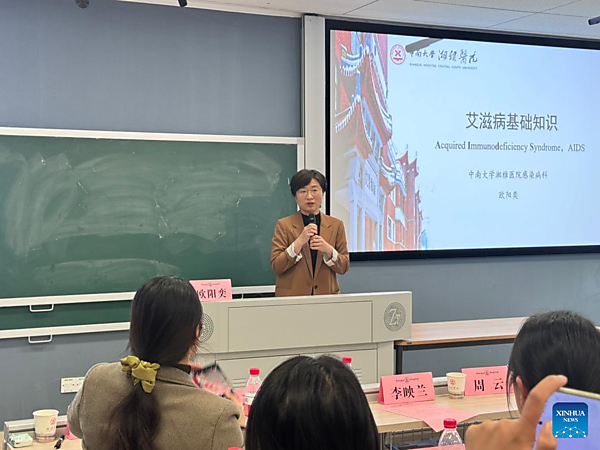 |
| Ouyang Yi, an infectious disease specialist from Xiangya Hospital, imparts HIV/AIDS knowledge in Changsha, central China's Hunan Province, Dec. 1, 2025. [Xinhua] |
(Source: Xinhua)
Editor: Wang Shasha