One would not expect to see countless animals, mythological creatures and even popculture icons soaring together in the sky. Yet, every spring, this extraordinary spectacle unfolds in Weifang — the World Capital of Kites, nestled in east China's Shandong Province. Traditionally, spring has been regarded as the perfect season for kite flying in China. More than 2,400 years ago, the world's first kite took flight — in Weifang. As the birthplace of kite making, the city is renowned for its time-honored kite culture, and for its exquisite kite craftsmanship. In 2006, Weifang's kite-making craft was added to the first group of items on the list of China's national intangible cultural heritage.
Brilliant History
China is widely recognized as the country that invented the kite. During the late Spring and Autumn Period (770-476 BC), and the early Warring States Period (475-221 BC), Mo Di (better known as Mozi), a philosopher, devoted three years to crafting a wooden bird, widely regarded as the prototype of the modern kite. Later, Lu Ban, a master carpenter and engineer, refined the design, by replacing wood with bamboo, to create a bamboo bird that could stay aloft for up to three days.
In their earliest forms, these flying devices were known as muyuan, or wooden kites, and they were crafted primarily for military purposes. On ancient Chinese battlefields, they served as essential tools for measuring distances, testing wind direction and transmitting signals.
Over time, artisans began crafting kites with bamboo frames and silk coverings. During the Eastern Han Dynasty (25–220), there was a pivotal breakthrough, when inventor Cai Lun improved paper-making techniques. His innovations made paper more accessible, giving rise to zhiyuan, or paper kites, the design that closely resembles the kites we know today.
However, it was not until the Tang Dynasty (618–907) that kites entered everyday life. As paper became increasingly affordable, flying kites evolved into a beloved form of entertainment, bringing joy to ordinary people.
The kite evolved into a cultural symbol during the Song Dynasty (960-1279). Kite flying was no longer merely a form of entertainment; rather, it had evolved into a way to wish away bad luck. In ancient China, on Tomb Sweeping Day (in early April), people would fly kites to express their longing for absent family members, and to symbolically drive away illness and bad luck.
During the Ming Dynasty (1368-1644), kite flying became increasingly popular in Weifang. Many artisans, who specialized in making kites, made their living in the city. During the Qing Dynasty (1644-1911), as the custom continued to flourish, the "Weifang kite" reached its golden age. Kite making and flying flourished as an art form, and achieved remarkable advancements in size, design, decoration, craftsmanship — and flying techniques.
Weifang kites made their way onto the global stage during the 1980s. The city has hosted the Weifang International Kite Festival since 1984. Each April, kite enthusiasts, from around the world, flock to Weifang to participate in kite competitions, and to enjoy the majestic, and colorful, spectacle.
Unique Style
Weifang kites are known for their elegant shapes, exquisite craftsmanship, vivid imagery, vibrant colors, remarkable variety, steady flight performance and for being made with high-quality materials. These qualities have made Weifang kites well-known, both at home and abroad.
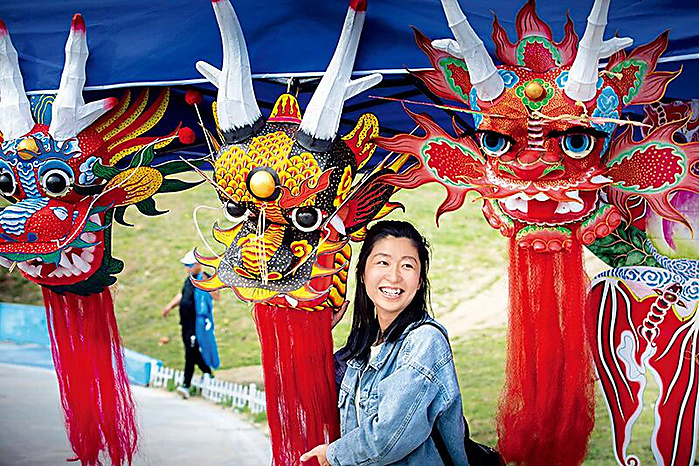
Rooted deeply in folk tradition, Weifang kites are distinguished by their strong local character. Their themes draw inspiration from the New Year picture, the traditional woodblock printing used to decorate homes during Spring Festival. As a result, the kites often carry auspicious meanings. Whether it is depicting human figures, birds and beasts, fish and shrimp, legendary figures, or mythical tales, each kite embodies a story — and a blessing.
Meticulous Procedure
Making a Weifang kite takes more than 30 meticulous steps, which are divided into four major techniques — framing, pasting, painting and flying. Each technique depends on the others; together, they form a living-craft tradition, which has been passed down through generations.
The frame of the Weifang kite is traditionally made with bamboo. The artisan begins by selecting the right bamboo, and then he/she shaves it into thin strips. After shaving and trimming the strips to the desired thickness, the artisan carefully bends them over a flame; a delicate process, which requires both strength and patience. Once the strips have taken shape, the artisan ties them together, with cotton thread, to form the skeleton.
When it comes to pasting, the choice of material — paper or silk — depends on the form and character of the kite. For example, silk is often preferred for a dragonfly kite, as its translucency mimics the delicate wings of a living dragonfly. An eagle kite, however, would never be covered in silk, as the soft fluttering of silk would hardly match the powerful, steady soar of a raptor. This thoughtful selection of materials gives Weifang kites their remarkable lifelike quality.
The painting of a Weifang kite is where the local character shines, vividly. During past centuries, artisans drew their inspiration from the vibrant painting style of the New Year pictures, the expressive brushwork of traditional Chinese paintings, and kite-making traditions from across China. The bold brushstrokes and bright tones — vivid red, yellow and green — create a striking visual effect. As the kites soar in the sky, they appear not merely painted, but truly alive.
Inheritance
Yangjiabu, a village in Weifang, is widely regarded as the home of the traditional crafts of making kites and painting New Year pictures. In ancient times, nearly every household in Yangjiabu mastered the skills of painting and making kites. These traditions have been passed down through generations, and they remain vibrantly alive to this day.
Yang Hongwei, a national-level representative inheritor of Weifang's kite-making craft, is regarded as one of the most dedicated guardians of this legacy. Yang was born into a kite-making family in 1966. She became an apprentice to Yang Tongke, her grandfather and a master kite maker, in 1982. During the past four decades, she has honed her craft, and she has created kites of various sizes, from giant kites, stretching 300 meters, to miniature kites, barely two centimeters in diameter.
For Yang Hongwei, kite making is not only a showcase of traditional craftsmanship, but also a bridge for cultural exchanges. In recent years, she has dedicated herself to helping "Weifang kite" fly ever farther. For example, she has demonstrated her kite-making skills in more than 20 countries, including Germany, France, Malaysia and the United States, bringing the exquisite craft to the world.
She has also done her utmost to help the craft take root among Chinese youngsters. She offers kite-making courses in primary and middle schools, which creates the opportunity for children to appreciate the charm of the time-honored tradition.
 |
| Xu Yuzhen, a district-level representative inheritor of Weifang's kite-making craft |
Xu Yang and Xu Yuzhen, Yang Hongwei's nieces, have learned to make kites from their aunt. Yang Hongwei has shared what she has learned about pasting and painting with her nieces. "What my aunt taught me goes beyond the craft itself. She often emphasized three principles when making kites: Quality, integrity and devotion to the craft," Xu Yang says.
 |
| Xu Yang, a city-level representative inheritor of Weifang's kite-making craft |
She is now a city-level representative inheritor of the craft. Xu Yang has promoted kite making in schools, communities and enterprises, to share its charm with as many people as possible. She hopes more youth will breathe new life into this traditional craft.
Photos from Interviewees and VCG
(Women of China English Monthly May 2026)
Editor: Wang Shasha